
Review – Earth

| Designer | Maxime Tardif |
| Artist | M81 Studio, Conor McGoey, Yulia Sozonik, Kenneth Spond |
| Publisher | Inside Up Games |
| Category | Engine/Tableau Building |
| Length | 45-90 minutes |
| Release Date | May 2023 |
| Player Count | 1-5 |
| Price | $50.00 MSRP |
My favorite board games are actually card games, or card-driven games, full of combos. Star Realms, Dominion, Res Arcana, Furnace, Living Forest and their ilk are perfect for a rehabilitated Magic player. So anytime an engine builder gets the level of buzz that Earth has, you better believe I take notice. Does the game live up to the hype? Let’s find out!
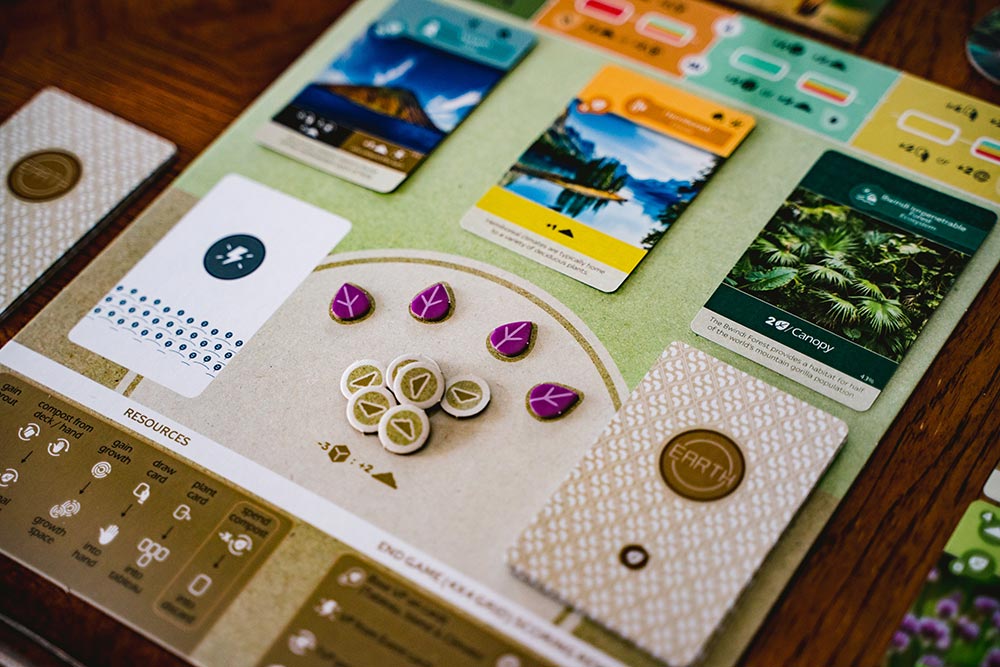
There is a thread on BoardGameGeek where the designer of this game basically explains why his game is better than Terraforming Mars, Wingspan, Race for the Galaxy, Ark Nova, and other beloved engine builders. Bold move, cotton. In some ways, he’s not wrong, though. In particular, this takes some of the best ideas from Race (the “folllowing” mechanism), Wingspan (activating particular bonuses based on your action), and Terraforming Mars (tags). Yet from these other games, Earth creates something fresh, even if not completely unique.
Since the game centers around picking an action on your turn that other players follow, it feels most like Race. But each action is color-coded, and cards already in your tableau have corresponding bonus actions to take if the right color is picked, and these activate even when you are following another player’s action. This means you’re fully involved in every turn, although the game is very multiplayer solitaire. Beyond following opponents’ actions and competing for some goals in the middle of the table (which you can still complete after your opponents do, for marginally fewer points), players are mostly playing beside each other rather than against each other, not unlike Wingspan. I only play Race for the Galaxy with two players, and I do think that the subtle interactions in Earth actually reveal themselves more in two-player games. On the other hand, the fast, simultaneous player is a draw for higher player counts.
As you build your grid of cards, you are mostly taking actions to… move things around. Cards become compost (think “tucked cards” from Wingspan), VP cubes (“sprouts”) become cards, soil (money) becomes growth (points similar to the cubes). Actually putting the cubes and cylindrical “growth” pieces on the cards looks great, and it helps that the art is fantastic. I think the game has a great design philosophy: no attacks, no hand limits, no conditions required to play a card – just do what you want! But any game like this has kind of a two-pronged approach: the actual ruleset, and then the actual text on the cards. After maybe a dozen plays, I have to admit… the cards are a little boring.
At first I was amazed. Compost 20 cards from your hand?!? How often do players have that many cards? (Often.) There are likewise some Terrain (endgame scoring) cards with a similar wow factor, and it’s fun to get a bunch of effects of the same color and activate them all at once. And on one hand, the effects have to be somewhat similar, so that a player with 20-30 cards in hand can quickly evaluate them and decide which ones are likely going to the compost heap. But the effects are all very similar to each other, although my much bigger problem is actually with the goals, which are all too similar, making them uninteresting. An expansion would help greatly; when I play the base game alone of Star Realms or Res Arcana now I’m a little bored, but that’s after thousands of games of the former and about two hundred of the latter. I love this genre and find myself seeing the cracks in the veneer after about twenty games.
The effects aren’t that different from what you see in other engine builders, so it’s taken me a minute to figure out why I feel this way about the card effects. But I think this is it: you can have combotastic turns in this game that feel long because you get to do a bunch of stuff, but they never feel clever or surprising. There’s very little drama in games of Earth, and that’s my favorite part of engine building games. To illustrate this, I rarely know who is winning at the end of a game – I’ve won unexpectedly, and I’ve crushed people when I thought I was losing. I don’t mean that there were comebacks; I mean nobody had a clue what was going on as far as actually winning the game. Compare this to the race to the victory conditions in Res Arcana or Living Forest, or the very public tracking of scoring and catch-up boosts in Quacks of Quedlinburg. The lack of drama is another quality the game shares qualities with Wingspan, although this time that fact is not in Earth’s favor.
But, I understand that the lack of tension is not a negative for everyone. If you hate feeling like the “pro gamer” player in your group combos out and ends games just as you were getting going, and you like the fixed number of rounds in games like Wingspan, this might be more your style. While the game does end on a player-controlled condition (a player plays their 16th card), it seems that it’s very hard to gun the endgame and most of the time, players have ample warning that the end is near. It also makes the game much more attractive as a solo game, if that is something you enjoy.
The other small complaint I have is that while the game is much shorter than its contemporaries Ark Nova and Terraforming Mars and probably Wingspan, it’s still a little too long for what it is. I really wish the initial Ecosystem and Climate cards were actually put into your tableau, both to accelerate the game and so that the yellow and blue actions were not underpowered-to-useless at the very start of the game (which often feels too scripted).
That said, the game is still pretty good. The ruleset is surprisingly smooth and simple, the components and artwork are stellar. I also really like the theme; there have been a sudden slew of nature and plant-themed games the past few years, and this is one of the best. The game is a very reasonable price ($50 MSRP) for its contents at a time when all prices are going up and up. Players who don’t like attacks in games, or having the chair knocked out from under them when a game ends unexpectedly, will love Earth’s design philosophy. While it’s not at the top of my list of engine building games, it’s still very good.
The Bottom Line
Despite the lack of interaction and tension, Earth is a very good tableau building game.
7.5
