
Review – Hanami
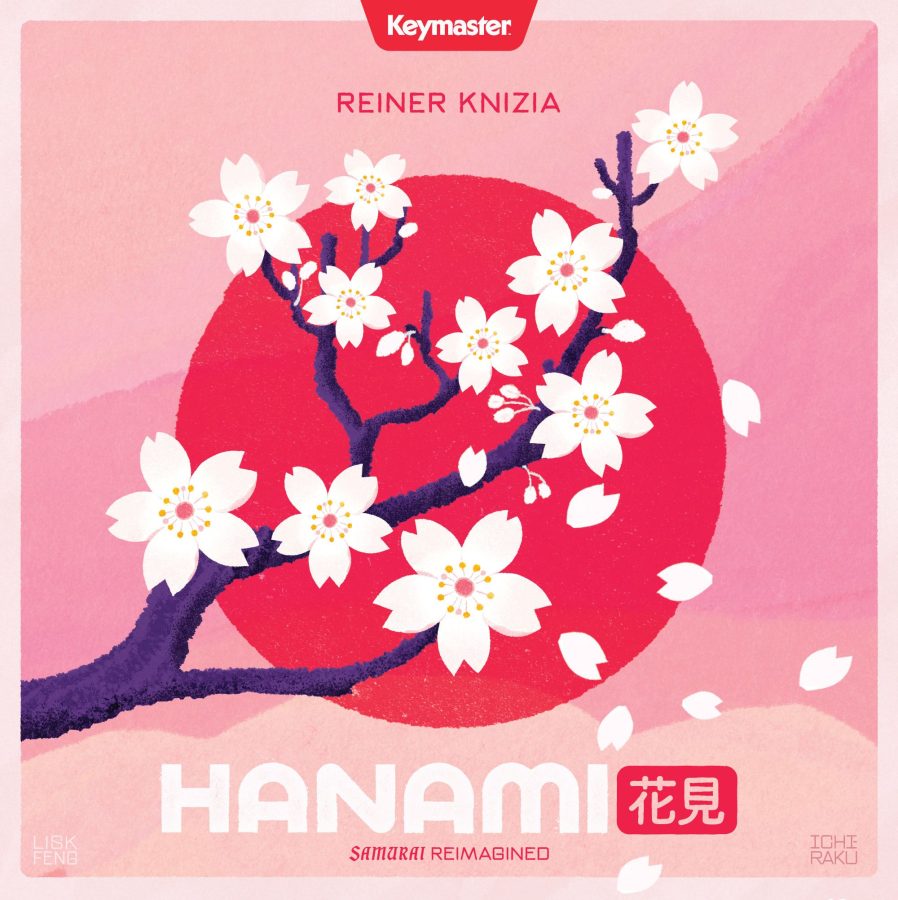
| Designer | Reiner Knizia |
| Artist | Lisk Feng, Ichiraku Shinhanga Seisakusho |
| Publisher | Keymaster Games |
| Category | Tile-Laying, Reprint |
| Length | 30-60 minutes |
| Release Date | August 2026 |
| Player Count | 2-4 |
| Price | $39.99 MSRP |
After years of exclusively playing Magic: the Gathering, a friend showed me Catan around 2008, and I haven’t stopped since. During those first deep dives into board game geekdom, I kept hearing about this mythical legend named Reiner Knizia, and among the many exalted classics of his was the game Samurai. I even owned the old Rio Grande edition at one point. Twenty-eight years after its original release, Samurai has been rethemed as Hanami, a much gentler and peaceful-looking tour of Japan, although the gameplay remains as cutthroat as ever. Can a game so old compete with the cult of the new? Let’s take a look!
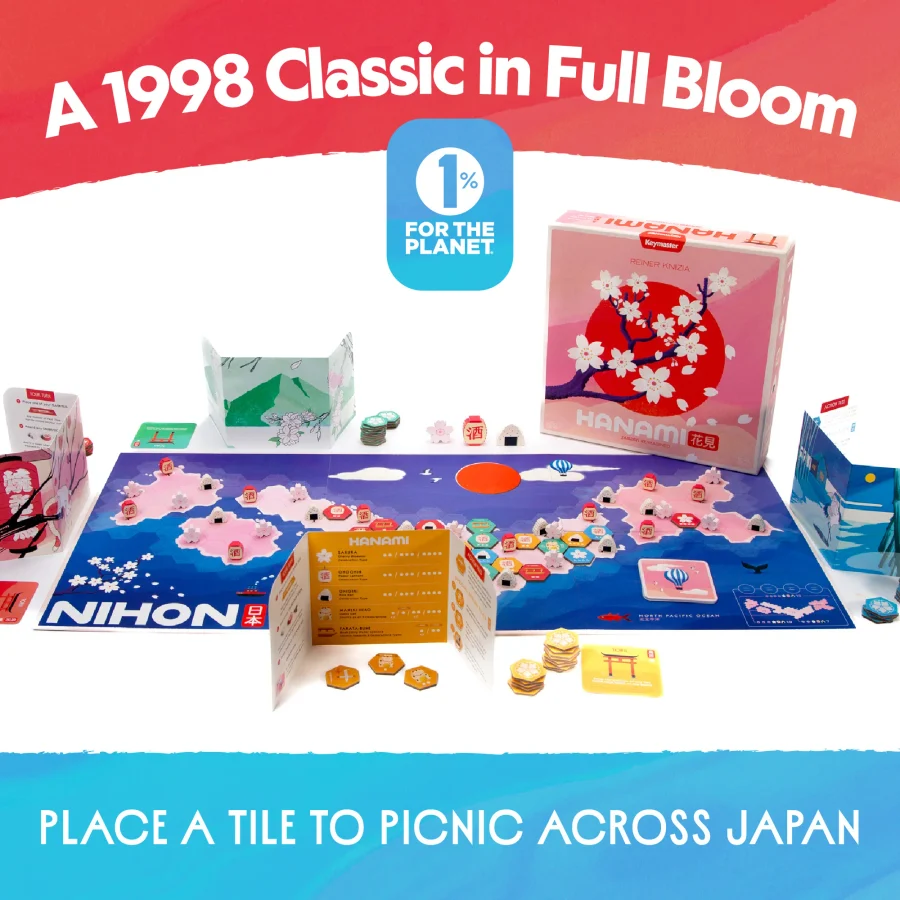
I’ve reviewed hundreds of games at this point, and played over a thousand, so many things don’t surprise me anymore. However, when I first viewed a deluxe copy of Hanami, I literally mouthed “wow” under my breath without meaning to. The standard retail edition looks just as good, and is a bit more functional (the deluxe board is too big). I don’t find the (literally) flowery theme a disconnect with the gameplay, as the game is fairly abstract anyway, and this is by far the most beautifully produced version of the game ever made. And honestly, while I was only middling on Samurai in the past, experience with the game and the beautiful production made playing this pure joy.
For one thing, while the scoring of the game is kind of obtuse, I felt like I had a much easier time explaining it than in the past, which is probably just due to repetition. The clear iconography and especially having the tiles listed and explained on the player screens made for an extremely smooth experience. And Hanami is a lightning-fast game, with a tense, sudden ending.
What’s there to complain about? Honestly, nothing. This is a perfect reimplementation of a timeless classic. The real issue, if there is one, is that Knizia is competing against himself. Hanami is a tile-laying game where, on your turn, you place one hexagonal tile onto a shared grid. That sounds exactly like Rebirth, Reiner Knizia’s 2024 game that just won the 2026 Kennerspiel des Jahres (it arrived later in Germany). As part of this review, I played both games back-to-back, as I was worried one would clearly muscle out the other. Fortunately, I was wrong.
Hanami has players holding a hand of tiles while Rebirth has players drawing a single new tile to play each turn. This isn’t too distinct, since sometimes there are only 1-2 good plays in your hand for Hanami, so much more important is the scoring, and that’s where the games vary wildly. Hanami involves set collection through a mechanism that feels like area majority, though it isn’t exactly that, and the sets themselves follow a similar unique mechanism. Meanwhile, Rebirth feels more like a card combo game, playing more and more tiles to escalate the points earned, and working on public and private goals to eke out “classic” victory points over the competition.
Despite the surface-level similarities of Hanami and Rebirth, (and the fact that the games even have the same box size!), both are distinctly great tile-laying games from the good doctor, considered by many to be the king of tile-laying games. Frankly, what I find most important about both games is the central board, because in an era when “take and make” games on a private board are a dime a dozen, this is a breath of fresh air. Even moreso, Hanami’s high level of interaction is also distinct in 2026, and the lovely art and theme blunts the knife’s edge. Even the subtle changes and additions are made with great respect to the original design, and offer significant variety. Frankly, it’s a perfect production, and while this is not my favorite genre of game, I don’t see you do it any better. For that, this game deserves full marks.
The Bottom Line
A perfect remaster of a timeless classic.
10
