
Review – Oasis: New Life on a Distant World
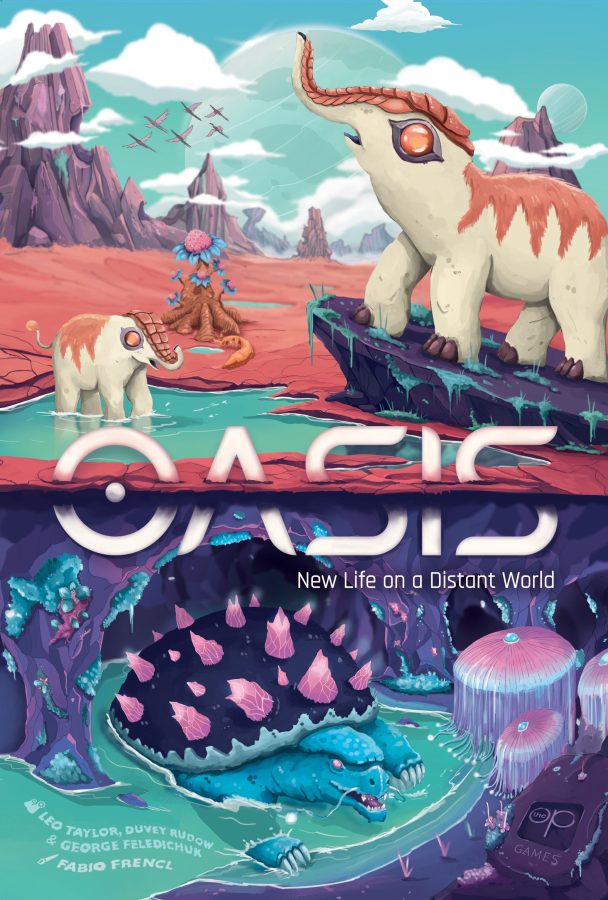
| Designer | George Feledichuk, David "Duvey" Rudow, Leo Taylor |
| Artist | Fabio Frencl |
| Publisher | The OP |
| Category | Tableau Building, Hand Management |
| Length | 45-60 minutes |
| Release Date | 2026 |
| Player Count | 1-5 |
Oasis: New Life on a Distant World is a game about building a thriving ecosystem on another planet. Over the course of 3 years/rounds, players work to create a balanced biome, while also preparing for the annual flooding, which will wash away part of their tableaus. Let’s check it out!
Review
In Oasis, 1-5 players compete to earn the most points by shaping a planet’s biodiversity. The game is played on individual player boards, each of which is divided into 2 rows: above ground and below ground.
To begin, everyone receives a hand of cards, consisting of 3 starting, subterrain cards, and 3 randomly-drawn surface cards.
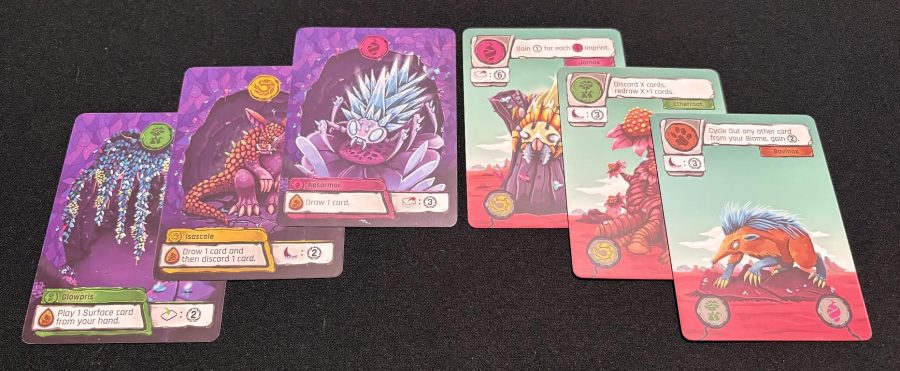
On a player’s turn, they take 1 of 3 actions:
- PLAY A CARD: Add 1 card to its respective row and resolve its effect (e.g., “Draw 2 cards” or “Gain 1 imprint token”)
- DISCARD TO CYCLE OUT: Discard a card from your hand, and then discard a card from your tableau, resolving its cycle effect (e.g., “Gain 3 points”)
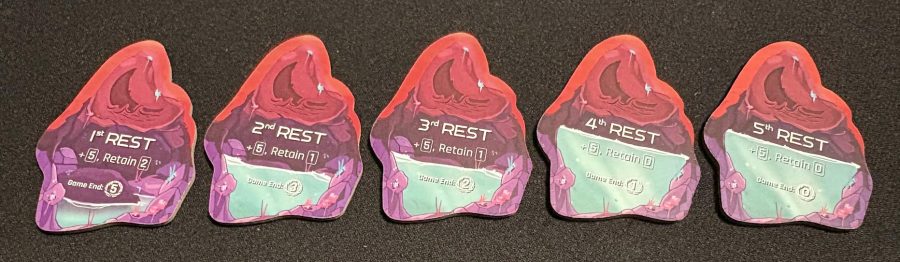
- REST: When you can’t or don’t want to take any more actions, this action allows you to pass. Resolve any Rest effects and take the topmost Rest tile, which may allow you to save subterrain cards for the next round, or gain game-end points.
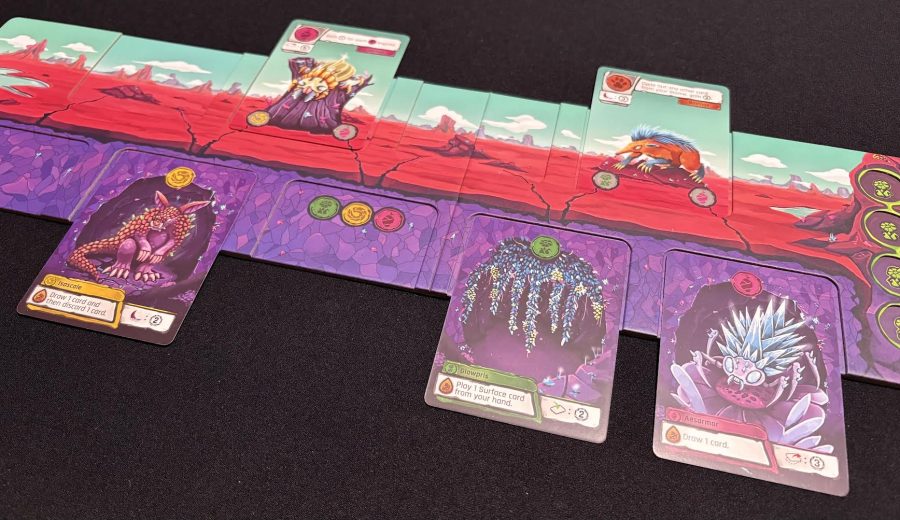
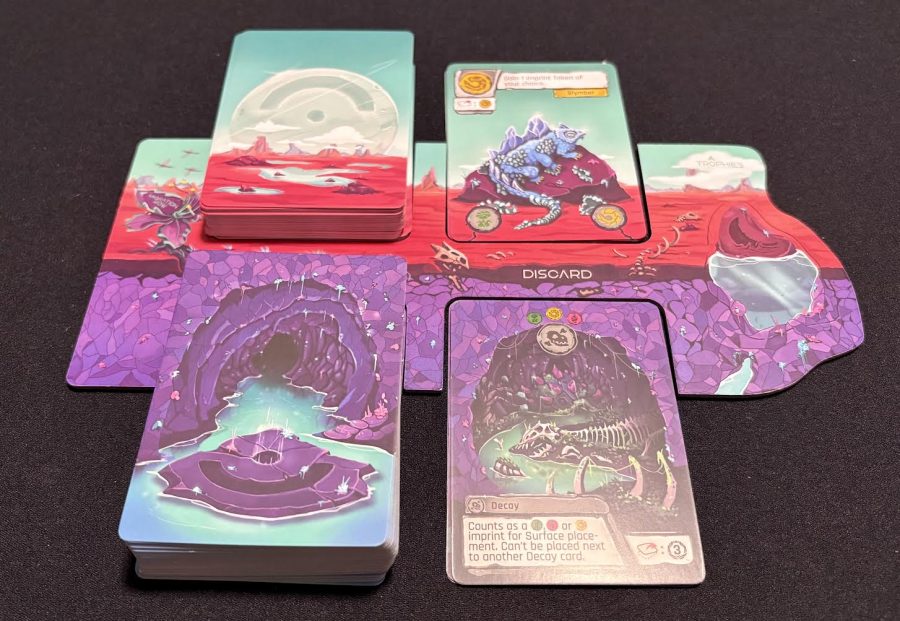
Subterrain cards can be played in any open space of the bottom row, and they are important because they inform what can be played above. Each subterrain card has an “imprint” icon, and each surface card requires a connection to 2 specific imprints — say, a yellow on the left and a green on the right. (The lines on the tableau board help to graphically link the top and bottom card rows.)
The strategy, of course, comes from trying to optimize the tableau. It’s partly about setting up imprint icons so as to play cards above, but it’s also about knowing when to cycle. Cycle effects typically provide points or imprint tokens, but cycling costs a card, so players need to weigh when and how often to do it.
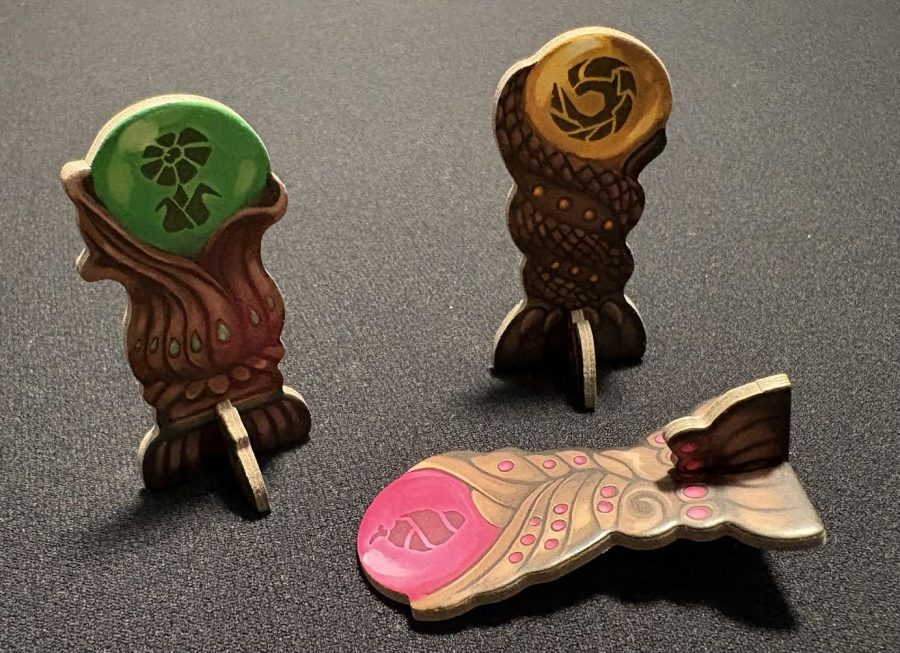
At the end of each year, when everyone has rested, players compare the number of imprints they have in each of the 3 main colors (other than gray, which is wild). For each color, the player with the most imprints earns a trophy, which is worth 5 points. Imprint tokens will also award end-game points.
Once end-of-round scoring is complete, the Flood phase occurs, in which all players clear the cards from their subterrain row. Any Flood effects are resolved at this point; these effects typically award imprint tokens. Depending upon which Rest tile a player has, they may be able to hold onto some of their subterrain cards. (The earlier they Rest, the more they can keep.)
The game continues like this until the third Flood phase has been resolved. At that time, the game ends and final scores are totaled. Players earn bonus points for imprint tokens they have collected, and then the player with the most points wins!
Before I even opened the box, I spent a good 5 minutes admiring the cover of Oasis: New Life on a Distant World. It’s gorgeous, like something out of No Man’s Sky. The card art is equally striking, and the visual created by the surface and subterrain together looks really cool.
The gameplay of Oasis is fun and engaging. Players have a number of considerations each turn, but the game is not overly heady or complex. The iconography is very intuitive, and the card actions are all straightforward. Strategically, players need to set up their subterrain row to accommodate the cards above, while also considering the order in which to play/cycle cards to maximize their actions. The turn-to-turn decisions are interesting, and they provide lots of room for clever plays.
One rule I didn’t care for is the tiebreaker for awarding trophies. If multiple players tie for the most imprints of a color, the tie goes to the player with the lower score. Clearly, this is meant to be a catch-up mechanism, but I would have preferred if ties went to the player who rested first. (I’ll note that rest order is the second-tier tiebreaker.)
As for scalability, Oasis works better at lower player counts. The game is almost entirely multiplayer solitaire, so more players means longer turns and more downtime. 2 players is really the sweet spot, and that’s the count I most recommend this for.
Overall, Oasis: New Life on a Distant World is a good family-weight release from The OP. It offers a snappy tableau-building puzzle with compelling cardplay and great visuals. It’s especially well suited for smaller groups, so if that sounds like something you’re looking for, check it out!
A review copy was provided by The OP.
The Bottom Line
Oasis is a clever design with simple rules and engaging gameplay. Recommended for fans of light strategy, especially at lower player counts.
7.5
