
Review: Mythos Tales
| Length |
| Release Date |
 Designer: Hal Eccles, Will Kenyon, Jason Maxwell, Tim Uren
Artist: Miguel Coimbra, George Patsouras, Edu Torres
Publisher: 8th Summit, Grey Fox Games
Category: Storytelling, Deduction
Players: 1+
Price: $39.51 Amazon.com
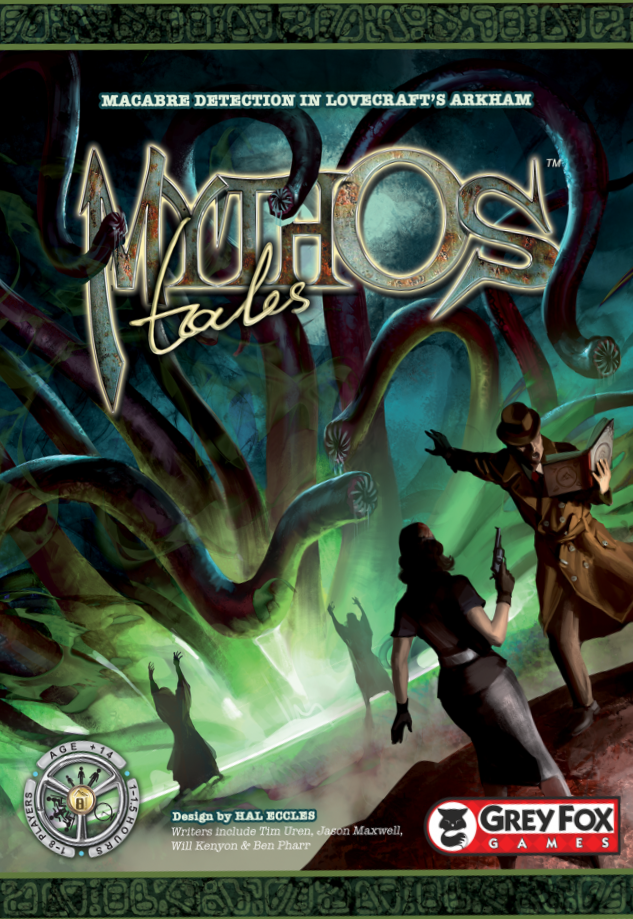
Mythos Tales is a standalone game in the tradition of Sherlock Holmes: Consulting Detective. Meant to be played as a campaign, it features eight cases for players to solve.
Content Guide
Mythos Tales is a story-based adventure set in H. P. Lovecraft’s Cthulhu universe. True to its source material, it is full of sci-fi horror themes. Players are pit against nightmarish “elder gods” from Lovecraft’s narratives, and they must investigate evil rituals, dark magic, and otherworldly occultism.
Review
Several months ago, I wrote a review of the 1981 classic and early Spiel des Jahres winner Sherlock Holmes: Consulting Detective. It is a story-based, “Choose Your Own Adventure”-style mystery game, played as a campaign over a series of “cases.” Though, at its core, it is really more of a freeform activity than a traditional board game, it is still widely regarded as a timeless masterpiece.
Enter Mythos Tales, 35 years later. A spiritual successor to SHCD, Mythos Tales takes its time-honored formula and paints it against the Lovecraftian backdrop of Arkham, Massachusetts.
Mythos Tales includes eight cases compiled in a satisfyingly-thick book, eight daily newspapers, a map of Arkham, a directory of its residents, and a list of allies in town. If these components sound familiar, it’s because they are basically the same as those in SHCD; again, the inspiration is undeniable.

Every case is a self-contained game. As one would expect, they should be played sequentially, as details from one case might be relevant to future cases. Each story begins with a narrative introduction, describing the mystery and providing information and leads. In addition to the case book, players can peruse the corresponding day’s newspaper, which will contain valuable clues and hints. Once the scene has been set, players can collectively choose a person or place to visit. Turning to the appropriate entry in the case book, they read what happens at the new location, and may continue to investigate until they either run out of time or feel they are ready to solve the case.
In a slight change from SHCD, cases in Mythos Tales use a time track. In the original, there was no limit to the number of people/places that players could visit. Of course, the less stops players made, the greater their endgame score would be, but since my group quickly gave up hope of ever besting the Master Detective, we just played until we had visited everywhere we wanted to go. In Mythos Tales, players are given a certain timeframe in which they must complete the case. Units of time are thematically represented by morning, afternoon, and evening, so players may have, for example, until the afternoon of the fifth day to crack the mystery (a total of fourteen time units).

It’s always difficult to review a game that contains surprises and secrets; the last thing I’d want to do is spoil the narrative experience for a reader. As such, I won’t go into specific details about the stories. This is the kind of game you just have to explore for yourself. However, I will say that I greatly enjoyed immersing myself in the game’s world. The Lovecraftian lore really comes to life through the storytelling, and it’s fun to feel like you’re part of the action.
When a game is clearly derivative of another game, it’s easy for it to feel uninspired and lazy (just think of how many mediocre deck-building games are out there). I am pleased to say that Mythos Tales stands on its own two feet when compared to SHCD; I actually think it’s better than its predecessor. Because these games rely so much on narrative, it doesn’t bother me that they are mechanically similar. As far as I’m concerned, the mechanics of this game are secondary to the overall experience. The exploratory nature of these adventures gives rise to great stories, and that’s what matters.
 When I reviewed SHCD, I mentioned that it was often cumbersome and confusing as players had to keep track of dozens of people, places, and facts in a messy web of interlocking stories. While I enjoyed that game overall, I felt like its challenge came more from a sheer overabundance of information than from actual deduction and sleuthing. Mythos Tales‘ story is drastically more cohesive, which significantly enhances its play experience. Don’t get me wrong, I’m not saying it’s easier, just that its story flows more organically. Instead of having to dig through pages of cryptic notes to remember what Porky Shinwell said at the bar twelve stops ago, players can just… play.
I’ll be honest, I didn’t think I would like Mythos Tales‘ inclusion of a time track. I enjoyed the freedom of SHCD, the ability to play as long as I wanted and visit as many places as I wished. My initial impression was wrong, however; the time track is an excellent addition, and it really strengthens the game. Having a known time limit makes players’ decisions feel much more important. No longer can they follow each and every lead just because. They have to make critical choices as the clock ticks. By the end of the game, the stakes feel high (as they should when Cthulhu is about to swallow you whole). Additionally, the in-game time limit keeps the overall game length reasonable. Where SHCD cases could sometimes take four hours, Mythos Tales cases take a more reasonable one to two.
This game offers a robust narrative adventure. Light on rules and heavy on theme, Mythos Tales throws players head-first into an otherworldly nightmare. Lovecraft games have more or less jumped the shark (or rather, the Pacific-Ocean-dwelling elder god), but this one is not to be missed.
Mythos Tales is one of those rare instances where the reboot is better than the original.
A review copy was provided by Grey Fox Games.
The Bottom Line
