
Review: Paperback
September 26, 2017 /
| Length |
| Release Date |
 Designer: Tim Fowers
Artist: Ryan Goldsberry
Publisher: Fowers Games
Category: Card Game, Print & Play, Word Game
Players: 2-5
Price: $24.99 Fowers Games
Paperback is a deck-builder where players simulate the roles of novelists trying to finish stories for their editors. The game was successfully kickstarted on July 16, 2013 to the tune of $37,493 and has since received a prequel, called Hardback, which is also a deck-builder. Paperback is expecting an expansion this year that will add 80 new cards, new abilities, typos, and 16 new covers.
Tim Fowers is a board and card game designer who owns Fowers Games. Fowers has also designed Hardback, Burgle Bros., Fugitive, and Word Domination.

Review

These Fame cards are essential to victory in Paperback.
Paperback was my second experience with Tim Fowers’ games. I had previously played and enjoyed Wok Star, so I was excited to try his other offerings. It’s an interesting mix between a deck-building game and a word game, takes 30-45 minutes to play, and can accommodate 2-5 players.
At the beginning of the game, every player receives a starting deck of cards containing the letters R, S, T, L, N, and five wild cards that can stand in for any letter. Decks are shuffled, and everyone draws an initial hand of five cards. Players represent upstart novelists, and they try to use these and other letter cards to make words as they write their stories.
Suppose on a player’s first turn, she draws the letters T, N, S, and two wilds. She can make words like “STAND,” “STONE,” or “TENSE.” Starting letter cards are worth 1¢ each, and wild cards are worth nothing, so if she decided to use one of these words, she would have 3¢ to spend during the buy phase of her turn. Using this allotted money, she can purchase cards from the market. These cards contain one or two letters, and occasionally grant special abilities when played, such as:
-
+3 cards next hand
-
+1¢ per wild in word
-
Double the score of an adjacent card

Nice dividers for a nice game.
The market consists of face-up stacks of cards, divided based on their color/cost. This means all the red cards, which cost 2¢ each, go in one pile, all the purple cards (3¢) go in another, etc., all the way up to teal cards (8-10¢)—the most expensive. Naturally, the more costly the cards, the better they are. Starting with the 3¢ cards, the top card of each stack is set beside the pile so that two cards of each color are visible and available for purchase. Additionally, the market includes four stacks of victory point cards (called “Fame cards” in this game). These are worth 4, 7, 10, and 15 points, and cost 5, 8, 11, and 17¢, respectively. At the end of the game, the player with the most Fame points is the winner.
The game can end in two ways, either when two Fame card piles run out, or when the last “common card” is acquired. This is one of the cleverest aspects of Paperback‘s design. Next to the market, four cards are placed in a staggered column. The topmost card of this stack acts as a common card, available to everyone. As long as it’s there, it can be used by any player, as if it were in their hand. The first player to make a seven-letter word gains the card for their deck, thereby revealing a new common card. This second card can only be acquired by making an eight-letter word, then a nine-letter word, and finally, if someone is able to make ten-letter word, they gain the final common card and the game ends upon completion of their turn.
The common cards are worth 5 Fame points each. Four of the six possible cards are vowels, and as you’d imagine, having a vowel floating through your deck is incredibly helpful. Players will really want to try for those long words!

Here, we’ve made the unique word “Pales.”
When a player has made a word, used appropriate abilities, and purchased new card(s), her turn ends. She will discard all cards from her hand, as well as any she purchased. She takes a new hand of five cards from her deck. When her deck runs out, she will shuffle her discard pile, which will likely include newly-purchased cards, to form a new deck.
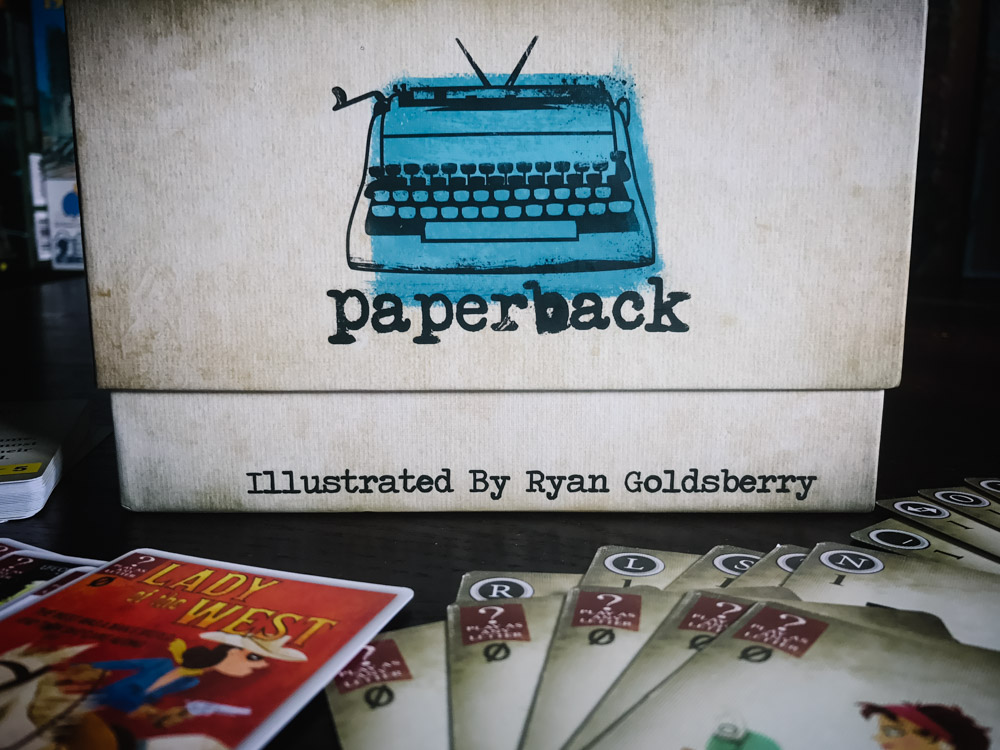
Presentation-wise, the game looks great. It comes in a so-called “butter box,” decked out in stylized, minimalistic art by one of my favorites, Ryan Goldsberry. The cards themselves have a very clean visual appeal; the whole package just looks classy. The theme of being an author doesn’t really come through, but that’s fine. It’s a nice theme, if a little thin.
I really enjoy the card abilities. They invite an extra touch of strategy without bogging the game down. If a player can make three different words with their current hand, card abilities might

All the extra variants and gameplay modes. Tons of variety.
make one of those words better than the other two. Thus, it feels like your decisions matter more. In my earlier example of a player’s starting hand, all three of the words I proposed would score exactly the same, so it wouldn’t really matter which one the player used. As you acquire more cards, however, your decisions start to become more meaningful and you feel a greater sense of agency.
I also appreciate that the Fame cards double as wilds. In Dominion, most Victory cards don’t do anything—they just sort of act as dead weight in your deck. Paperback gives Fame cards a secondary use, so, while they’re not the strongest for making words, they at least have some value besides simply points.
I’ll come right out and say it: I generally don’t care for deck-builders or word games. It should come as no surprise, then, that Paperback is not my favorite. It’s very well designed, just not my thing. Tim Fowers has managed to combine two genres of games into a smooth, streamlined system, and I can see a lot of folks liking Paperback. Deck-building games can easily feel like uninspired Dominion knock-offs, but this game feels different. It feels like its own experience, and I like that about it. If you’re into word games and/or deck-building games, I definitely suggest giving Paperback a try.

A review copy of Paperback was provided by Fowers Games.
The Bottom Line
