
Review – Harmonies: Crescendo and Harmonies: Pulse
| Designer | Johan Benvenuto, Mathieu Rivero |
| Artist | Maëva da Silva |
| Publisher | Libellud (Asmodee North America) |
| Category | Tile-Laying |
| Length | 30 minutes |
| Release Date | September 2026 |
| Player Count | 1-4 |
| Price | $19.99 MSRP for Crescendo; $7.99 MSRP for Pulse |
Harmonies is one of my most-played games of the past few years. It’s beautiful, fast, and just the right level of brain-burning for a 30 minute game. In fact, I still find it a crime that it was not nominated for the Spiel des Jahres. Fortunately, it was successful enough to earn not one but two expansions. Should you get one over the other, or just get both? Let’s take a look!
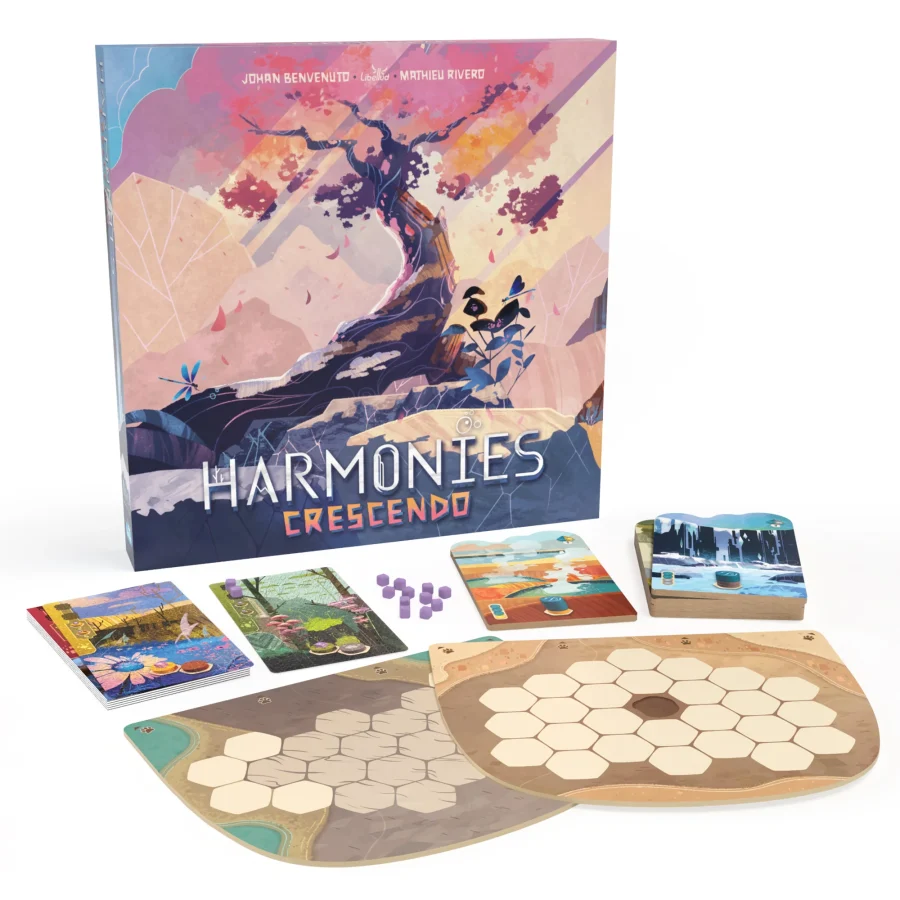
I have to start with the obvious: I have no idea why these expansions were released simultaneously and separately. Crescendo is a $20 expansion with three modules, while Pulse is a $8 “booster pack” of just 10 cards. Couldn’t this have been one product!? I have really mixed feelings about these expansions, and it starts right here.
However, let’s start with the good news. In my mind, Harmonies is one of the best “take and make” tile-layers out there (and there are dozens); I consider it superior to Cascadia, Azul, Calico, and other “top” games in the genre. For me, only Barenpark comes close. The reason I’m saying all that is that since I consider Harmonies an incredible game, expansions can be kind of a danger. You want increased variability, but you really don’t want increased complexity or length. (In fact, I eventually got rid of Barenpark: Bad News Bears for these reasons.) Didn’t I mention good news? Here it is: Harmonies: Pulse is an amazing expansion and worth all the few pennies it costs.
The 10 cards in Pulse add no new rules. It’s literally just 10 new Animal cards to add to the central deck, which have high scoring power but require 3 different terrain types instead of two. They are mind-bendy enough to create some new strategies and real brain-burning moments, with zero friction. I wouldn’t even bother removing these from the deck with new players. The rules include a card to explain how symmetry is allowed for these new formations, but I found them fairly easy to intuit. When you consider the fact that the original deck only had 32 Animal cards to begin with, this is a pretty significant change!

Now, along the same vein, another “obvious” ask from players would be for new, alternate player boards. More good news! Crescendo includes a new board for each player, with a side C and a side D. Whereas side “B” changed Rivers, now side “C” changes Cities scoring, and side “D” changes how Forests and Fields score. They also both have an extra rule or concept with the geometry of the board, but I found these rules interesting, clearly demarcated, and easy to remember. If Asmodee had given us one expansion for Harmonies with the 10 cards from Pulse and the new boards, I would be SHOUTING about how this is the best board game expansion ever made, and the review would stop right here with an 11/10 score.
However, they didn’t do that. For some reason, we’ve got two different packages,and I’m less enthused by the other modules in Crescendo. I don’t actively dislike them, but they’re not “auto-includes” like one would hope.
There’s another pack of 10 cards (which is perhaps why Pulse ended up separate), and these cards all score the same way. They’re relatively easy to accomplish but only have two cubes to place per card, which are purple instead of gold. The cubes only score 2 points normally, but can score 5 points if they share placement with a gold cube, which is allowed here for the first time. I have two problems with the “Whisper” cards. The first is that because they’re so easy to do, it seems like you should always take them. In the first few turns, there might be a real opportunity cost that should have considering other cards instead. But after that (especially with only two players), the set of Animal cards on offer can really stagnate, so when one player takes a risk and takes a middling card to open things up, these can often just be “automatic” points for the opponent. The other issue I have is that if you combine these with Pulse, the deck has gone from 32 cards to 52, and now it’s seriously diluted, which makes the game feel a bit more random (and it already has a fair amount of randomness involved). I’ve played enough Harmonies and been stomped enough times on BoardGameArena to know the game involves some serious strategy, but I also think it has a near perfect amount of randomness and swinginess as it is, and wouldn’t want to push it too far in either direction.
The last module is the “big” module from Crescendo, which are 10 Sanctuary tiles. Three are present at any given time, in a separate display from the Animal cards. You can take one in addition to your Animal card for the turn, but they share the 4 “incomplete” spaces on your board. You finish Sanctuaries by completing a stack 4 pieces high, combining pieces in normally illegal ways – always of two particular colors, which define the Sanctuary. When complete, the Sanctuary scores 3 points for each surrounding piece of its colors, but it also lets you take any unfinished Animal card in those colors and put the very last cube on the Sanctuary, allowing you to finish pesky cards that always seem to have one more cube than you want.
In theory, the Sanctuary cards are great. Unlike the base game’s Nature’s Spirit module (which can you force down a certain path early on), you can wait until the Sanctuary makes sense for you to take it (assuming your opponents do not), and it can even allow you to “pivot” a particular space on your board from a space that isn’t scoring well to a spot to build a Sanctuary. Being able to finish cards (you can do this multiple times) with a Sanctuary can also net a lot of points… when the stars align. The problem I have with the Sanctuaries is that they require a ton of mental space, constantly: should I take them now? Can I build that weird shape? Will it be useful at all? How do I build around it? Harmonies is already a spatially demanding game for a relatively short game, and my friends and I found the Sanctuaries to demand too much mental energy without providing equal “fun factor” compared to playing without them.
However, one big advantage is that the Sanctuary cards are easy to implement (or not); there’s no need to (un)combine components, so I intend to give these a few more tries, but I’m not convinced after 7 games. I will say, however, that one advantage is that it can be much more fun to min/max a solo game for a crazy high score when these are involved. On the other hand, though, I was disappointed that the solo game’s “star” system was not updated anywhere in the new rulebook to adjust for the new components.
Like I said, I don’t actively dislike the Whisper cards or the Sanctuaries. But neither have me eager to include them again, let alone every single game. Harmonies isn’t just its rules but also its cards and terrain tile distributions and scoring systems; it’s a very delicate ecosystem. I found that the new boards and the Pulse cards injected new life into that ecosystem without any consequences, but the other two modules were a tradeoff.
When your favorite musical artist releases a masterpiece album, except for one mediocre track, would the album have been better without it? Do we punish the artist for giving you more music? It’s hard for me to say. After all, Crescendo is intentionally modular, but the “day one DLC” vibe of Pulse also rubs me the wrong way. For now, though, I’m happy to have both expansions, and they aren’t exorbitantly expensive. But for the foreseeable future, I’ll be enjoying the new boards with the Pulse cards mixed in and not much else.
The Bottom Line
The odd packaging prevents me from giving these full marks, but there's plenty for Harmonies players to love.
8
