

Overview
| Synopsis | As the French and Indian War rages around him, a young George Washington guides a group of Virginia militia and British regulars to fight back against violence and interference in the Ohio territory. |
| Length | 2 hours, 5 minutes |
| Release Date | July 3, 2026 |
| Rating | PG-13 |
| Distribution | Angel Studios |
| Directing | Jon Erwin |
| Writing | Jon Erwin, Tom Provost, Diederik Hoogstraten |
| Composition | Benjamin Botkin |
| Starring | William Franklyn-Miller, Mary-Louise Parker, Kelsey Grammer, Andy Serkis, Ben Kingsley |
I must admit that I continue to be confused by Angel Studios’ business model. I’ve been wrong about them before, sometimes egregiously, but I tend to find that their best works are their least controversial ones (Brave the Dark, Last Rodeo, Sound of Hope). They seem to ping-pong between ideologies and topical issues with abandon, making quasi-mainstream movies with bizarre/contradictory political statements (Sound of Freedom, Cabrini, Animal Farm). Somehow they can book major secular talent like Jeff Daniels, Seth Rogen, Andy Serkis, and Jared Harris while maintaining the reputation of being “faith-based.” Any film studio that somehow manages the feat of being accused of being “woke” AND “Q-anon adjacent” has some very strange cooks in the kitchen. Thankfully, their newest film is one that not only stands out as solid but also fascinates me personally with its subject matter!
Content Guide
Violence/Scary Images: PG-13 action and violence; depictions of war with shooting, stabbing, and some blood.
Language/Crude Humor: Limited to none.
Drug/Alcohol References: Some casual drinking.
Sexual Content: Themes of courting and love.
Spiritual Content: Extensive discussions about the nature of providence and failures.
Other Negative Content: None.
Positive Content: Themes of overcoming failure and despair, self-sacrifice, and courage.
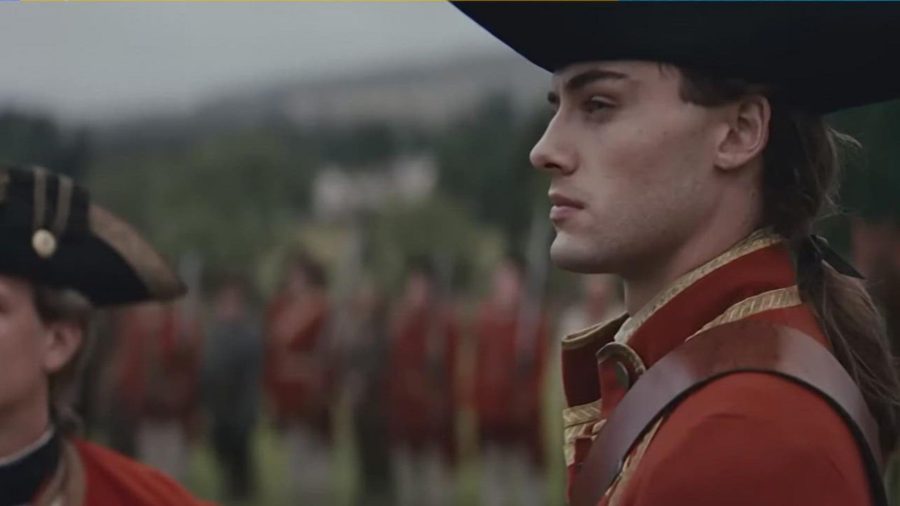
Review
In his remarkable book Washington: The Indispensable Man, biographer James Flexner describes the early career of George Washington as a period marked by amateurish failure and ambition. The young Virginian tenant farmer-turned-surveyor wanted to become a British officer, but was stymied by a lack of formal education or gentry.
His campaigns during the French and Indian War were marked disasters, wherein he twice marched soldiers into the Ohio Valley to be cut down by combatants fighting in warfare styles unfamiliar to European leaders. And yet, his humility, presence, courage, drive, and seeming invulnerability set him apart and marked him as a local war hero; setting him as the logical man to lead the continental army a generation later. It was not his competence that made him mythic, but his character.
As Flexner argues, his journey to discover the reality of the man buried under nearly 300 years of history is challenging because we project ourselves onto that history. He’s “admired” and “despised,” psychoanalyzed and deified, by people who are reacting firstly to the version of him cast in statues. But as he writes, “I found a fallible human made of flesh and blood and spirit, not a statue of marble and wood. And inevitable, for that was the fact, I found a great and good man.”
This is the rich narrative territory that Young Washington takes advantage of to great effect. Released to coincide with the 250th anniversary of the signing of the Declaration of Independence in July 1776, it explores the transformation of one lowly American boy into a leader who would unite his nation, inspire generations of Americans, and change the world.
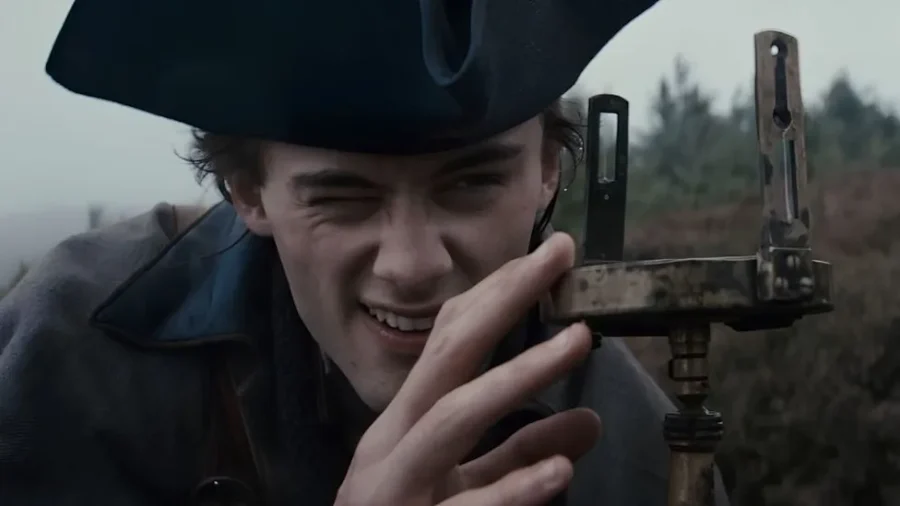
Set against the 1740s and 1750s, we meet a young George Washington in the aftermath of his father’s untimely death. His brother Lawrence Washington steps in early in his life to take that place, becoming his educator and guardian until his own early death. Faced with limited prospects, the ambitious young man sneaks into a party hosted by the local Lord Halifax (Kelsey Grammar) and earns a surveying job in the Ohio Territory through his sheer ambition, which he slowly works into a non-sanctioned military role with the Virginia militia, and leading to becoming an advisor to Major-General Edward Braddock (Andy Serkis).
Throughout the film, the young colonel is beset by regular failure and condescension, being largely undone by his own arrogance and ignorance. His actions are so clumsy that they accidentally serve as the spark for the French and Indian War. A constant theme throughout the film is the issue of aristocracy. Washington’s commanders view the colonists as lower class and uncouth, and constantly underestimate them. They maintain royal decrees and powers from a position of haughtiness, while the lowly locals have an actual on-the-ground understanding of the seriousness of the situation. As Washington is repeatedly told throughout the film though, he may just be their pawn but “a pawn can beat a king.”
Similarly, the film also draws blunt theological depth in the issue of providence. The real George Washington was an Anglican with a deeply private faith—claimed alike by Christian Nationalists and New Atheists due to some vagary in his language. The movie beats this theme like a plowshare without subtly, effectively turning it into the movies moral through a handful of sermons about “failure being our best teacher” by his mother Mary Washington (Mary-Louise Parker). Much like prior Angel Studios films, it feels like a secular war movie with a tacked on theological message.
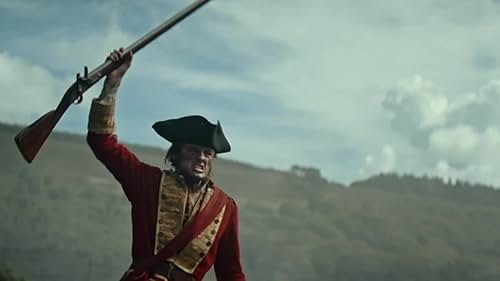
Whatever shortfalls the film suffers in its dialogue, it makes up for with solid production design and action scenes. Despite a modest budget, it uses its two primary action set pieces efficiently. Washington’s first two major expeditions into the Ohio territory are given great focus, with a number of great character moments, clever tactics, and enough grit to capture the tension of 18th century combat in an engaging manner. We get a sense of Washington’s capability on the battlefield, as much as his sheer bravery, as well as his famous penchant for avoiding bullets.
Despite its heavy-hitting cast, including notable actors like Kelsey Grammar, Andy Serkis, Ben Kingsley, and Mary-Louise Parker, actor William Franklyn-Miller is really responsible for carrying the film on his back. He’s the only actor on screen for every scene, given that he is playing Washington. Likely due to budgetary reasons, the other actors mostly get relegated to cameos. Thankfully, William does a solid job capturing the broiling tension under the surface of a stoic young man who is nonetheless eager to prove himself, and yet is also wrought with guilt for his failures. By the end, he does well to capture the presence of a man who can inspire others to follow him.
I’ve written before that there is already a shortage of movies and TV-shows about the American Revolution. There are a handful (1776, The Patriot, John Adams, Franklin, Drums Along the Mohawk, etc) and of course Hamilton is extremely popular, but the period has mostly fallen by the wayside in mainstream Hollywood (see this excellent video essay as to why). If I have any bias here, it is merely that this is a period of history I adore and seeing these events in full cinematic glory is unusual and novel. Even as someone who can see its flaws—its moralizing dialogue and overt marketing tie-in to a major American holiday—I cannot help but admire that it is doing the impossible merely by existing!
Positives
+ Solid performances
+ Solid production design
+ Fascinating history
Negatives
- Overbearing dialogue and themes
- Modest budget
- Cameo appearances by major actors
The Bottom Line
Young Washington is an imperfect but entertaining historical drama that manages to tell its modest story in an inspiring way!