

Overview
| Synopsis | Set roughly a decade after the original series, Avatar Aang finds himself with the incredible opportunity to bring airbending back to the world when another ancient airbender is discovered hidden in the ice. |
| Length | 1 hour, 39 minutes |
| Release Date | July 25, 2026 |
| Rating | PG |
| Distribution | Paramount+ |
| Directing | Lauren Montgomery |
| Writing | Tim Hedrick, Christopher Yost |
| Composition | Jeremy Zuckerman |
| Starring | Eric Nam, Dave Bautista, Jessica Matten, Román Zaragoza, Dionne Quan, Taika Waititi, Geraldine Viswanathan, Ronny Chieng, Ken Jeong, Dee Bradley Baker, Steven Yeun, Freida Pinto, Ke Huy Quan |
The two-decade qualitative arc of the Avatar: The Last Airbender franchise is one of the strangest in modern fiction. Despite mostly staying in house under the same original creators, the chemistry has never matched the success of the original Nickelodeon series (2005-2008). The Last Airbender (2010) is one of the most infamous blockbusters of its generation, while the recent Netflix remake (2024-2026) is at best a schlocky-but-modest live-action improvement that scrambles the original plot in a blender to worse results. The Legend of Korra (2012-2014) has its defenders, but doesn’t nearly live up to the series that it spawned from (a reality the show even acknowledges in a metatextual way, with a protagonist who considers herself a failure compared to her predecessor).
Content Guide
Violence/Scary Images: PG-rated action violence with battles, martial arts, philosophical musings on death, and a character disappears into nothingness when he dies.
Language/Crude Humor: Limited to none.
Drug/Alcohol References: Limited to none.
Sexual Content: Limited to none.
Spiritual Content: The story’s lore is heavily influenced by eastern religions like Buddhism and Hinduism.
Other Negative Content: Limited to none.
Positive Content: Themes of acceptance, friendship, trust, and hope.
Review
Despite past failures over the past 21 years, the Avatar franchise is entering a new phase. The newly formed Avatar Studios (2021) has been slowly baking a series of new movies and TV shows as original content for Paramount+, as well as new comics and original novels to expand the franchises’ backstory. The newly premiered trailer for Avatar: Seven Havens (premiering on October 9) has already drawn a great deal of online discussion for its art style and premise. More immediately though, the newly premiered original movie Avatar Aang: The Last Airbender is the first product to escape this production mill.
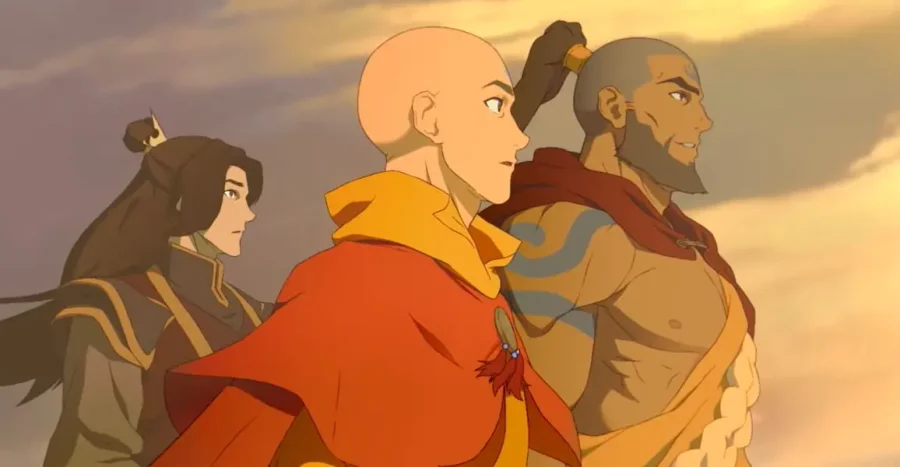
Set as an epilogue to the events of Avatar: The Last Airbender, the story picks up years after the events of the original series. Aang and his friends are all young adults now, each focused on rebuilding the world in their own special ways. Aang is traveling the world collecting Airbender relics, when a mysterious cult of anti-bending extremists attack and set him down the path to discover another ancient Airbender frozen in ice, with a mysterious past and knowledge of the location of an artifact that could restore the air nation to its former glory.
The movie’s premise leans heavily into the “Last Airbender” subtitle. While Legend of Korra touched upon the anxieties of what it means to be the sole inheritor of an entire culture’s ancient legacy, the film centers it as its dramatic core. We know Aang survives another half century after this story and isn’t really in danger. However, we do begin to see the connecting tissues of how child Aang becomes the leader of a new liberalized world where ancient divisions and traditions are giving way to a new understanding of common humanity.
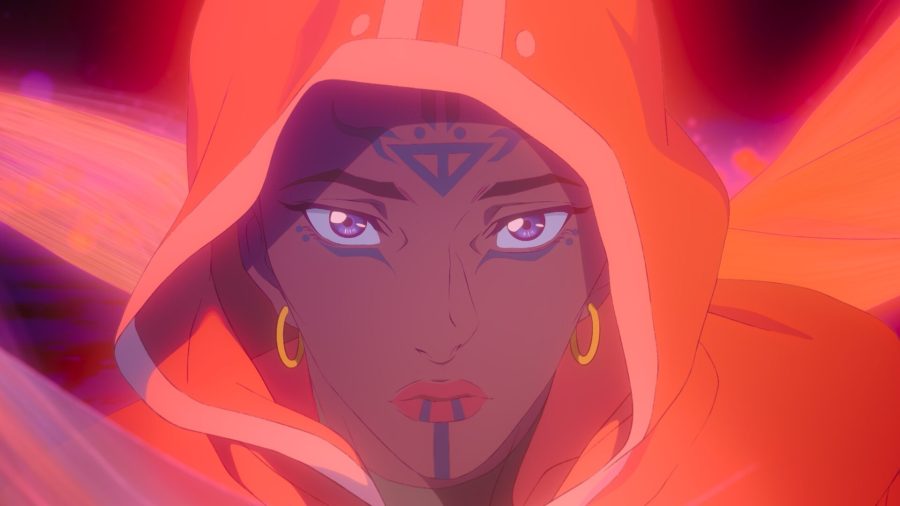
Aang’s central motivation in the film is the preservation of his culture, something that Katara directly states is holding him back and isolating him. He’s becoming more reclusive, especially at a moment when his friends are spread across the four nations, and struggling to connect with others and imagine a future where airbending survives. As he astutely points out, his dying at any moment could mean the end of his culture. It is only through trust and hope that he starts to see the possibility of a new world come into being.
Given that the premise of Seven Havens implicitly suggests that the hopeful promise of a united humanity will lead to some sort of apocalyptic event during Korra’s lifetime, the weight of hope against the unending strife at the heart of human nature feels fleeting. There is a naivety to Aang in this film that the story is actively rooting against—preferring the chaos of hope to the reality of what will happen as a direct consequence of his actions.
In that light, the movie functions as a very tragic lament for what it means when the old world transitions into the new world. It shows that trying to drag the old world back into modernity comes at too high of a sacrifice; that secularism and modernity are a challenge to be navigated and not merely undone by bringing something backwards and dead into the present. It argues that some things must be let go. If this is any indication for the future story direction, I suspect the franchise going forward will be about finding personal balance, identity, and meaning in a destabilized world where tradition cannot be relied upon (that or the creators didn’t think through the implications of the story in light of the events of Korra).
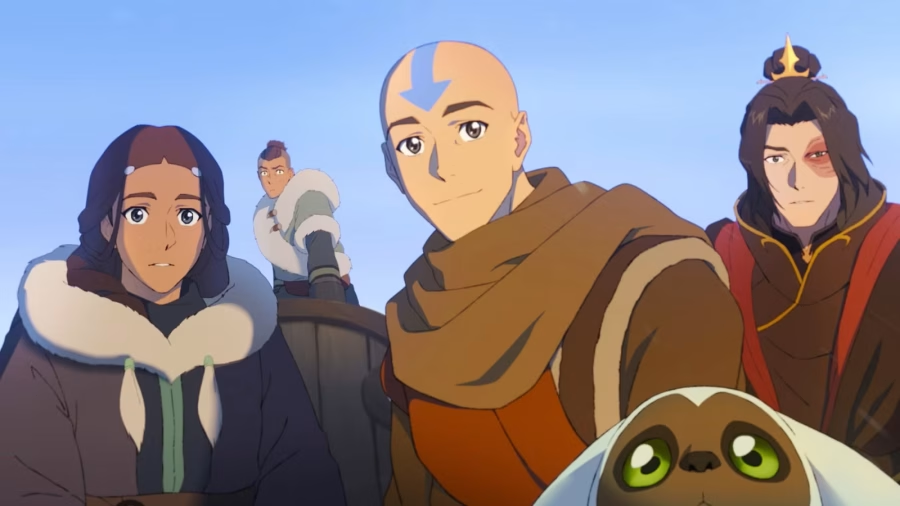
As far as execution goes, Avatar Aang is the single most visually beautiful and exhilarating depiction of bending that has yet been put to screen. The years of effort from Avatar Studios are on full display, with small facial movements and epic moments of action being given intense detail and thought. While the film does occassionally descend into fan service homages (they bring back the “my Cabbages” and foaming mouth guy), the movie as a whole is cohesive enough to work, mostly drawing on the status quo depicted in the graphic novel adaptations. And thankfully, the humor mostly lands (I appreciated the brief Jojo’s Bizarre Adventure reference).
Curiously, the fanservice and high quality execution doesn’t extend to the voice cast. Most of the original actors have been replaced, with many of the side characters being filled out with celebrities like Dave Bautista, Taika Waititi, Steven Yuen, Ken Jeoung, and Ke Huy Quan. The renewed focus on diverse voice actors, largely of Asian backgrounds, is admirable, but their performances skew heavily from the original voice cast to a noticeable degree.
Overall, I think Avatar Aang shakes out as one of the better things the franchise has produced since 2008. Granted, that isn’t necessarily a high watermark. Sarcastic Chorus noted in his review that the movie feels like an anime original movie (meaning flashy but not substantive), but the general audience reaction is generally positive. The online fanbase reaction seemed to be mixed. I do think this is more of nostalgia project before the new series kicks off, but there is still something innately cathartic about seeing Aang again as a fully realized Avatar who is nonetheless achingly human, vulnerable, and driven by the same idealism as his teenage self. I don’t know if this signifies a bold new direction for the franchise or a one-off success, but I am interested to see where things go from here!
Positives
+ Beautiful animation
+ Fascinating themes
+ Strong story continuation
Negatives
- Underwhelming voice acting
- Light fanservice
- Potentially undercooked execution
The Bottom Line
Avatar Aang shakes out to be one of the best Avatar projects in nearly two decades, building a nostalgic and visually exciting story that falls flat at times, but still manages to hit strong heights!