
Overview
| Developer | Nintendo |
| Publisher | Nintendo |
| Genre | Puzzle Platformer |
| Platforms | Nintendo Switch |
| Release Date | February 16, 2024 |
Nostalgia is powerful. And it doesn’t take more than a casual scroll on Disney+ to see that it’s also profitable. That’s what makes remakes so tempting for big companies. While it’s easy to get cynical about this seeming lack of originality, it is possible to make a remake that genuinely breathes new life into the source material. The Tony Hawk Pro Skater 1+2 remake pack is a prime example. That’s why I was eager to give this year’s Mario vs. Donkey Kong remake a try. Is this just an appeal to “the good old days,” or does this title stand the test of time and deserve its fresh coat of paint?
Content Guide
No objectionable content.
Review
To be clear: I have never played the original Mario vs. Donkey Kong. But I have played its prequel: Donkey Kong. No, not THAT Donkey Kong; the one released for the Game Boy in 1994. And that game is itself a sort of remake of the original Donkey Kong for arcades and the original Nintendo Entertainment System. (Are you confused yet? Good.) I have a little bit of experience with this style of game, but suffice it to say that I’m judging the remake both as a standalone game as well as a remake.
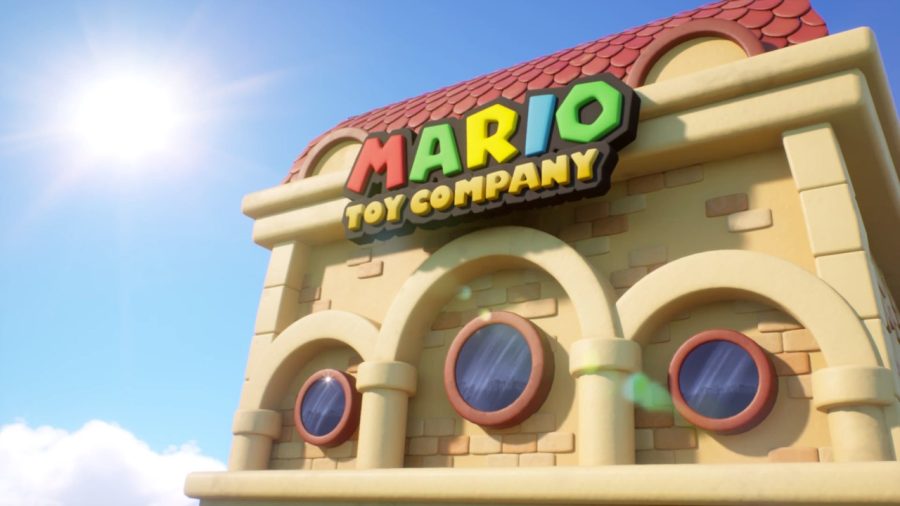
Mario vs. Donkey Kong’s story is…well, it’s a Mario story. DK is watching TV when he gets an ad for a set of Mini Mario figures. He falls in love with them, invades the Mario Toy Company, and snatches a pile of them. Mario, ever the involved CEO, chases after him to get that precious merchandise back. Not gonna win any Pulitzers here.
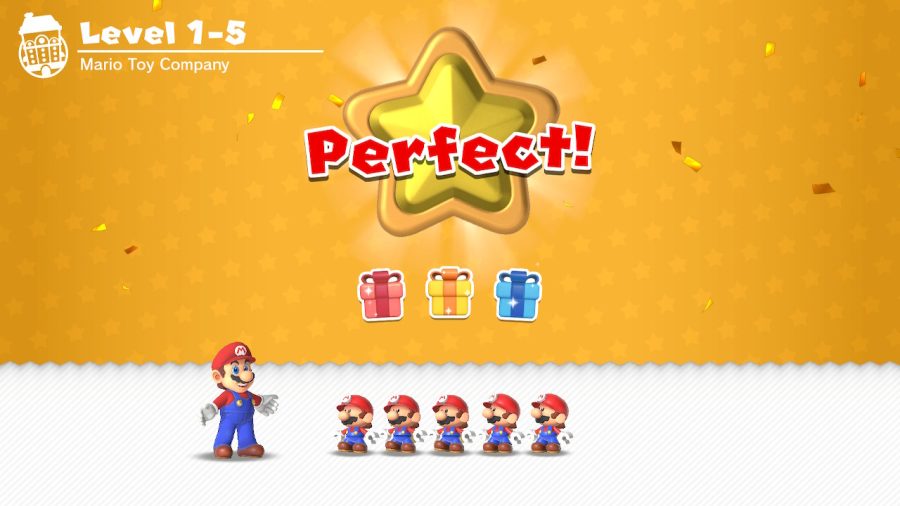
The game is separated into 8 worlds, with 6 levels each. These are followed by a Mini Mario level and a boss fight against DK. Each regular level is in two parts. In the first part, you need to bring a key to the door that DK has run through. In the second, you have to make your way through the stage to retrieve the Mini Mario. To do that, you’ll make good use of Mario’s acrobatics and the obstacles that DK has thrown in your way. After completing six levels, you’re tasked with a final Mini Mario level, where you have to guide the Minis back to their toybox. After that, you take on DK in a boss battle, then head to the next world to do it all over again.
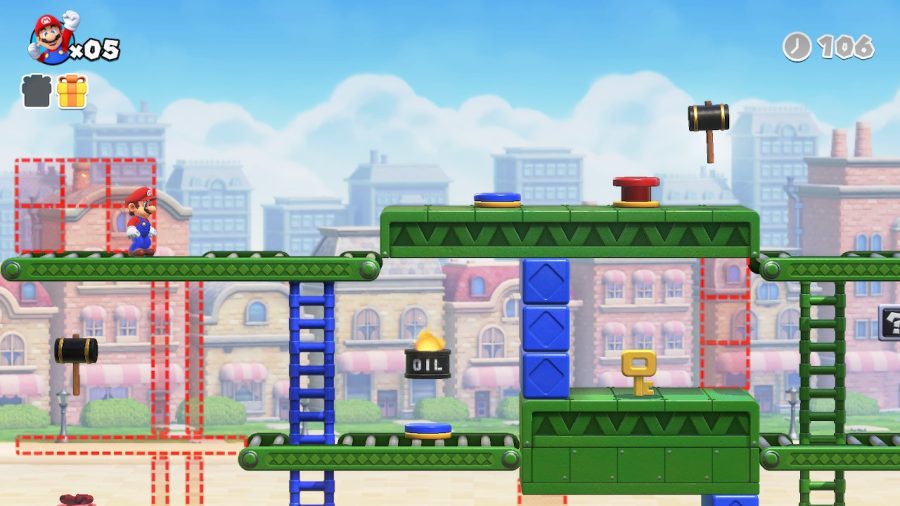
If you’re expecting a traditional 2D Mario platformer here, think again. This is a puzzle platformer through and through, meaning there’s a lot less death-defying jumps and a lot more head-scratching going on. That’s definitely not a bad thing; the puzzle designs are wonderfully creative. The mechanics are simple, but the game mixes enough of them together that some of the later levels really had me stumped. Mario can jump on enemies and pick them up and throw them just like in Super Mario Bros. 2. This means you can use enemies as platforms across spikes, or as ways to fit through small gaps. In later levels, you can turn blocks and platforms on and off with special buttons, and you’ll have to carefully think about how to order your actions to make sure the blocks you need are active when you need them.
But while the puzzle designs themselves were fun, I’m not actually a huge fan of the way you navigate them. Mario’s walk speed is pretty slow, and there’s no way to speed him up. In addition, the jumps feel a lot less predictable than something like Super Mario World. And yes, I know it’s not a traditional platformer, but it was still frustrating when I made a jump fully expecting to make it, only to tumble into the spikes below. And you have to start the section of the level over every time you die, meaning that you can be nearly to the end, only to make a stupid mistake and have to retrace your steps all over again. I wasted upwards of 10 lives on one level, and at least 2 or 3 of those were because I just couldn’t read the situation clearly enough.
In addition, some of the levels are needlessly tedious. I don’t mean complex, I mean just slow. Once you’ve figured out how part of a level works, it’s a pain to have to sit on slow platforms as they make their way back up to the part of the level you haven’t figured out yet. Then, if you die because of an unexpected obstacle or the sometimes difficult control scheme, you’re back to the start just to play the waiting game again.
However, the game bridges the gap between action and puzzles very nicely, especially with the Mini Mario levels and boss levels. The Mini Mario levels add an extra layer of strategy, since you’re not directly controlling the Minis. Instead, they’ll will follow Mario wherever he goes, but can’t jump more than one tile. You’ve got to figure out a way to get them where they need to go without ending up squashed yourself. This sort of multitasking is a welcome break from the main game, and I wish there were more of these levels.
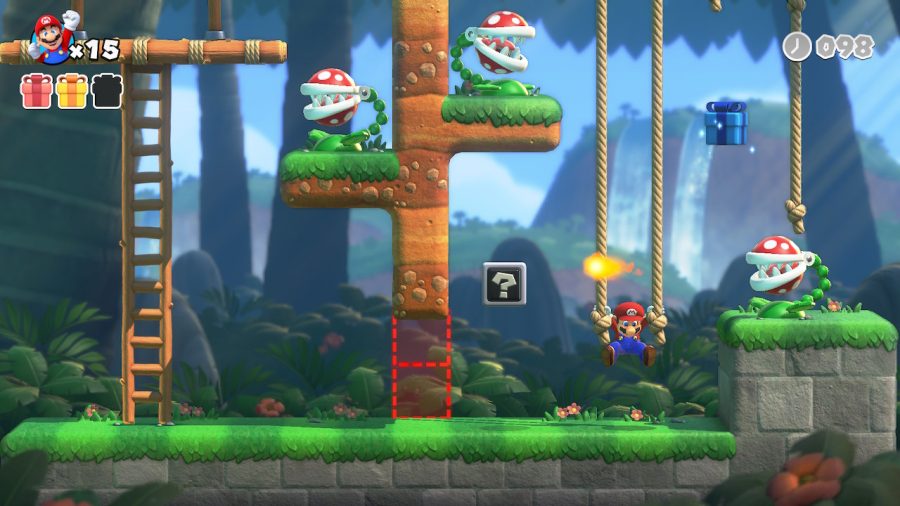
The boss levels, too, are a nice change of pace. In each, you’ll have to face off against DK in a variety of different scenarios. In some, he’ll toss barrels your way, while in others he’ll mindlessly bang on buttons to change the level layout on the fly. My personal favorite was one where he tosses Bob-ombs at you, and you’ve got to carefully time your button presses to guide it down a maze of conveyor belts right onto DK’s head. This is a perfect blend of action and puzzles, and each boss battle felt unique and well-suited to the overall theme of each world.
2D Mario games have always controlled vastly differently from the 3D games, making Mario vs. Donkey Kong’s hybrid of the two styles especially odd. You can side somersault, just like in Super Mario 64, but you’re only dealing with two axes of motion. In addition, you can handstand to protect yourself from hazards falling from above, and do a triple-handstand jump to get more height. It’s surprisingly responsive, and I found myself completing levels in non-standard ways all the time just because of some of the heights I could reach with a well-timed jump. It almost feels like the Metroid games in a way, allowing you to use skill to bypass otherwise tedious level layouts.
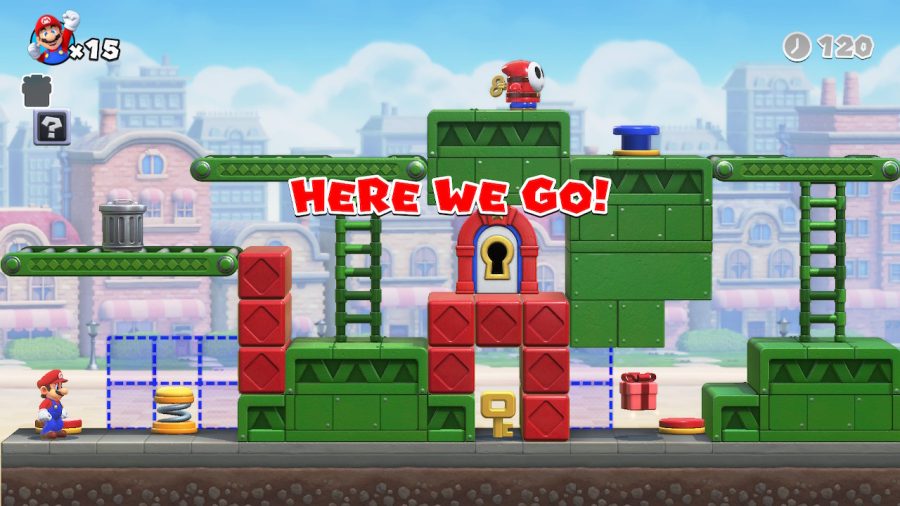
That’s the gameplay. If you’ve played the original, you’re familiar with all that. So what does this remake do to justify its existence? First off, the graphics. The original Mario vs. Donkey Kong used pre-rendered sprites on the GBA’s…lacking resolution. The result was something resembling Donkey Kong Country, but squished onto a screen the size of half a credit card. This remake replaces those sprites with 3D models, which look far better on our newfangled 4K televisions. And while the models look fine, I feel that the in-game animations are a bit stiff. A lot of this is due to the somewhat restrictive controls, so it’s understandable, but it does look a little off after seeing Mario’s expressive movement in titles like Super Mario Odyssey.
But what the game lacks in gameplay animations, it makes up for in its between-world stages and cutscenes. These are animated with a level of care that other Mario titles could learn from. DK is definitely the standout here, with a very expressive face that fits his ridiculous vocalizations perfectly. My main complaint is that the game uses the same animation for each world’s intro, rather than giving them anything distinctive to set them apart.
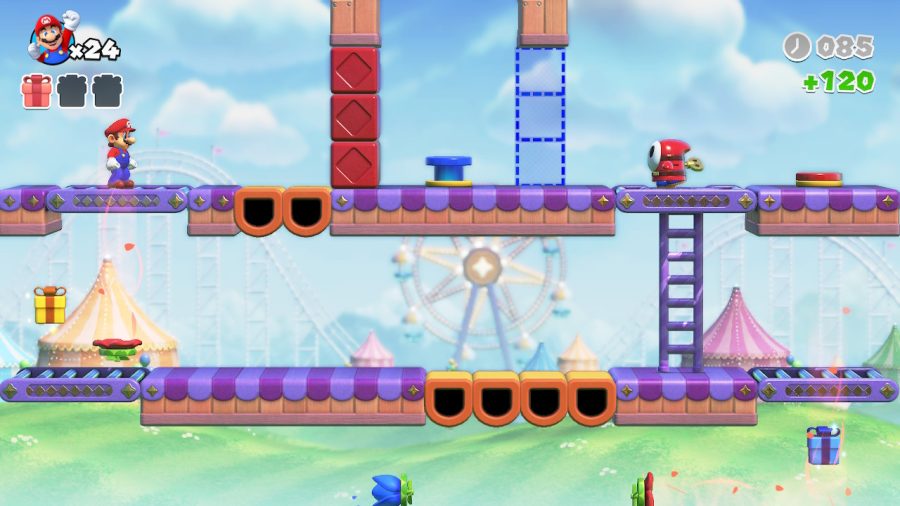
The music has also been completely redone, and it’s probably one of my favorite parts of the remake. When you’re in the city, you’ll hear jazz-inspired tracks, while the ethereal Mystic Forest has some surprisingly beautiful ambient music. The music never distracts from the action, but it’s not pointless filler either, and I love hearing the ways composers rework older compositions held back by hardware into a new generation.
Conclusion
Mario vs. Donkey Kong is unlike any other title in the Mario series, aside from its predecessor on the Game Boy. But that doesn’t automatically make the remake worth the $50 price tag. While the game boasts over 130 levels, most of those levels are very short. My time with the game was over in less than 10 hours, but I haven’t touched the new Expert levels, which do make up a sizable addition. But I’m not sure I want to go back to them, since I was pretty much done with the game by the time I finished the main mode. It’s obvious that this game was originally made for a tiny handheld, best played in short bursts rather than longer sessions. The remake doesn’t do much to change that. It would have been awesome to get both the Game Boy game and the GBA sequel together in one package, but as it stands, I was left feeling a little underwhelmed by what I got.
If you’ve never played the original and are in search of something new, Mario vs. Donkey Kong is a fun, if a little short, romp. Its unique puzzles, fun atmosphere, and slower-paced gameplay make it a good fit for the Switch. But if you’re familiar with the original, the only new content you’re getting is the Expert levels, and I’m not sure that’s worth $50. In an age where games like Final Fantasy VII are getting vast reimaginings, this one just feels even more like a relic of its past. Compared with the ground-up remakes of titles like Link’s Awakening and Super Mario RPG, Mario vs. Donkey Kong ends up feeling a little…well, mini.
The Bottom Line
Mario vs. Donkey Kong is a blast from the past that, while unique and fun, doesn't do enough to breathe new life into a classic title.
Why are you watching Disney+ ?