
Overview
| Developer | Seismic Squirrel |
| Publisher | Seismic Squirrel |
| Genre | Narrative RPG |
| Platforms | PC |
| Release Date | 03/31/2026 |
Aether & Iron is a narrative-driven RPG that takes place in a Decopunk alternate reality inspired by 1930’s bootleggers and games like Bioshock Infinite. You’ll play as Gia Randazzo, a down-on-her luck smuggler with little more than her wits and her car to see her out of many tight situations. Players will interact with 100s of characters, often with multiple choices to influence or persuade a conversation, given that you can successfully pass the skill check. And when talking fails, you’ll have to contend with turn-based car combat that sees you shooting, ramming, or when the situation calls for it, escaping much like the tabletop games Fast & Furious: Highway Heist or Thunder Road: Vendetta. So is it a noir-drenched good time, or does it all come crashing down to Earth? Read on for the review!
Content Guide
Violence:
In-game combat is all done in your vehicle. Players can shoot, ram, and destroy enemy cars and also civilian cars, causing them to crash out of sight. Often defeating a target enemy will just result in them verbally lashing out at Gia in a short text window. No blood or gore is shown. Some cutscenes have people dead or dying with small amounts of blood.
Language:
Light swears using d’s, nothing harsher.
Drugs & Alcohol:
Several scenes take place inside bars or parties serving alcohol; players can also get cigars or expensive spirits that can be sold for cash or used to bribe authority figures to look the other way during certain checkpoints or skill checks. Gia has a pack of cigarettes in her home base that you can click on and she says, “I can make it one more day,” suggesting that she’s trying to quit.
Review
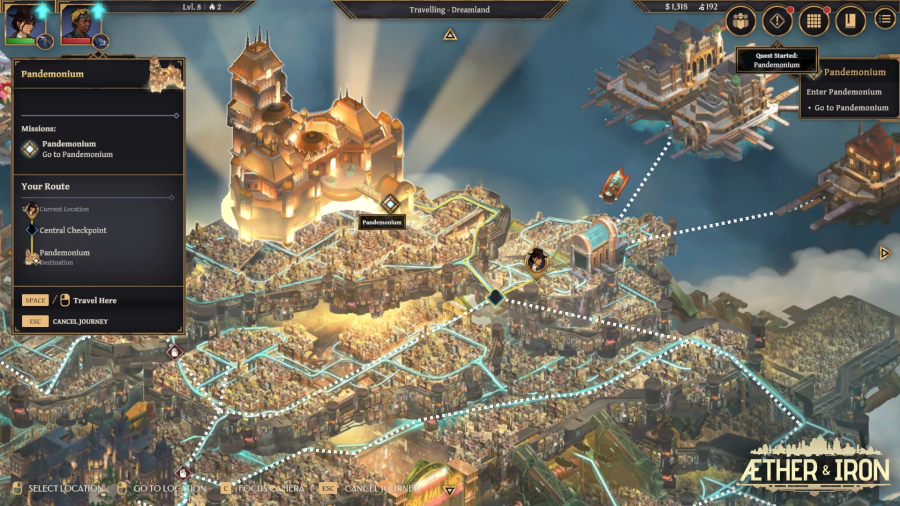
Aether & Iron puts you in the shoes of smuggler Gia, who starts out with a sweet ride and a black mark on her name. Inevitably, she loses the car but her initial goal of removing the black mark blooms into a much larger narrative as she makes new allies and falls into the Underground, who fight against the controlling Barons who govern the floating islands that make up this alternative-history noir New York. As the game progresses you’ll learn more about the islands and the Barons who control them, as well as unlock new islands to explore.
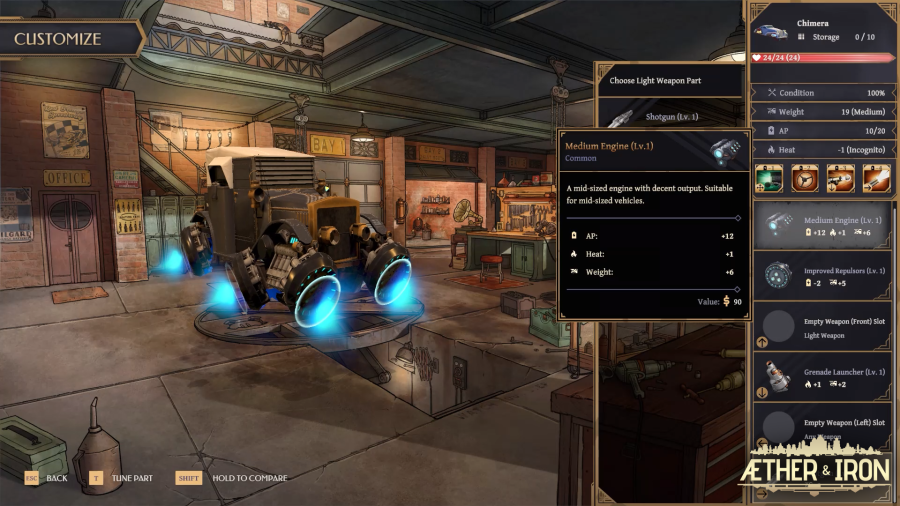
The tech that makes the islands float (and the cars) is powered by Aether, an interesting material that can also power weapons, if it falls into the wrong hands. Think of it as this universe’s version of Vibranium. The hovering cars are still all 1930’s themed, but with glowing hover tech instead of wheels. Players can outfit their ride with weapons, armor, auxiliary abilities, extra storage, and new engine parts as well as purchase new rides themselves. Each person you add to your crew can drive another vehicle, which also functions like their inventory storage.
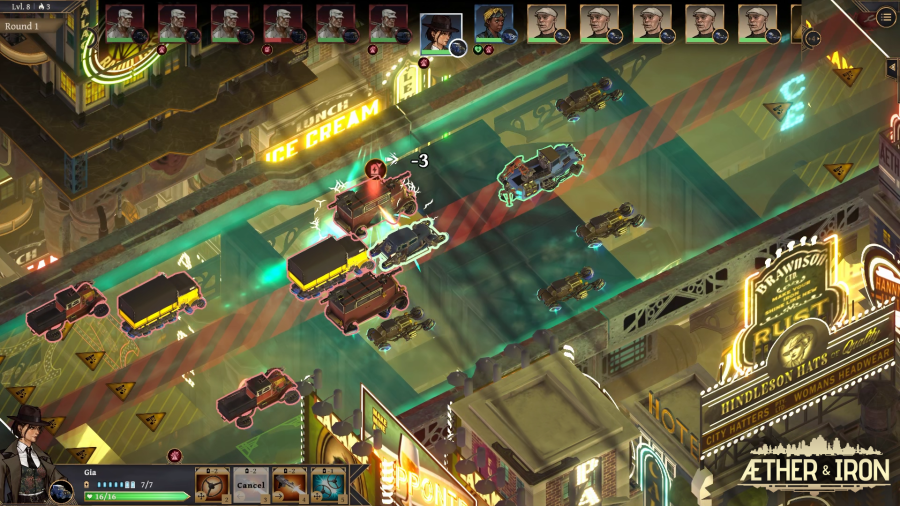
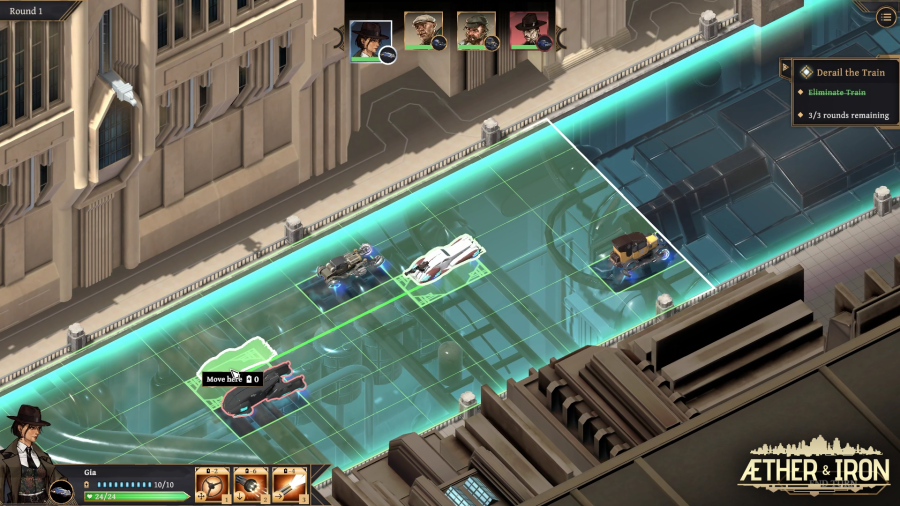
Vehicular combat functions much like a tabletop game; players will have Action points (AP) that they can spend to move, attack, and activate abilities like swapping places with another car or just jumping over them. It costs more AP to move up the road than to drop back, and depending on what abilities you’ve unlocked in the skill tree you might be able to do different things with certain characters. Vehicles that lose all their hit points will immediately drop back and damage anyone behind them, and there’s also environmental hazards to avoid. Overall it’s a fun and satisfying way to settle one’s differences when talking doesn’t work out.
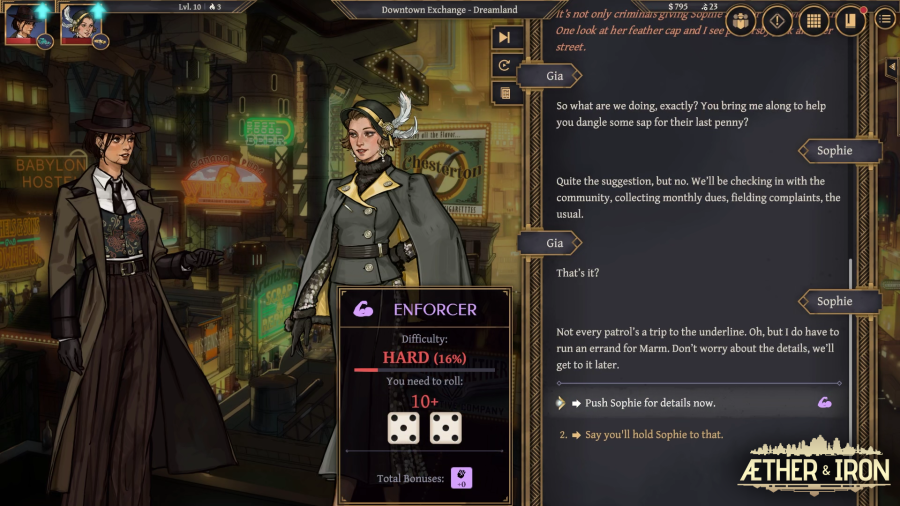
Speaking of, most of the gameplay will take place with Gia talking to different people. Barons, merchants, blue-collar workers, waiters, bystanders, and scientists all have different things to say that may help you finish your missions. Players will click through different options, and may end up having new or different options to ask about depending on what you’ve learned. At different points in a conversation, a topic may come up that requires a skill check. Pass it, and you may learn more or succeed in your mission. Fail, and you could learn nothing or find yourself looking down the barrel of a gun. Skill checks will see 2 six-sided dice rolled, plus a skill die if you have anyone in your crew with points in the skill being tested. The skill die doesn’t roll, but is always equal to the crew’s total skill in that area (so if someone has 3 points in Gumshoe, the skill die will be +3). The highest I’ve seen a skill test is 12, so in theory you could pass even without having any points in the governing skill, but your chance of success will be very low. The game even helpfully points out the percent chance you might succeed a given skill check, in case you want to try your odds with a different option.
Gia and her crew are all given skill trees, but from what I’ve seen so far Gia is the only one with the option of 3 different trees to choose from; the crew only get 2 each. Diversifying your crew with different skills will help you pass more checks easily: there have been several times where my 2D6 roll was just barely not enough, but I had a +2 thanks to someone’s skill in that ability, and it made me succeed. You get a small experience boost when you pass a skill check, but the large chunks of experience that will help you level up come from completing missions. You can also have Surprise Encounters going to and from different locations, and whether these are narrative or combat can be random, or also depend on your Heat level or if you’re able to talk your way out of a given situation. Players can also detour to a Safe House to let their Heat level cool off a bit.
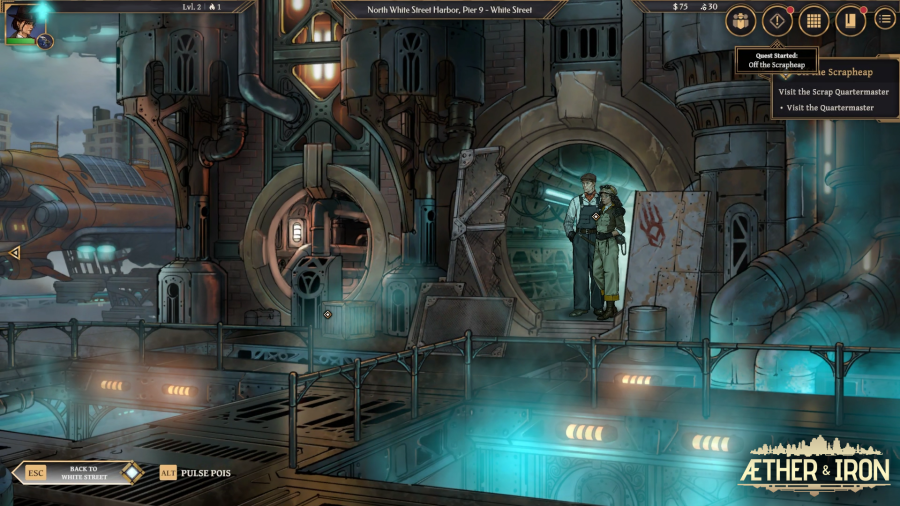
Aesthetically, the game leans hard into the noir tropes, but only as a jumping-off point. Gia has a black fedora and a black trenchcoat, and exudes the “tough as nails Private Eye” exterior, while actually being much more of a 3-dimensional character as you get to know her and how she got her reputation and nickname. Throughout most of the game a sad, soulful saxophone lingers with minor accompaniment, giving the feel of a jazz bar just past its heyday. The Decopunk styling makes everything look high-tech and glitzy (in the nice parts of town) while still maintaining that retro-futuristic feel. The voice acting is superb, and each of the main characters manage to sound unique and interesting without veering into annoying or gimmicky; this is key, since the narrative scenes have static drawings that only change sometimes with different responses. This might sound restrictive, but actually just reminded me of an anime.
Aether & Iron is a narrative role-playing game with turn-based car combat set in a noir Decopunk alternative-history 1930s New York. While that is a mouthful, it’s also one of the coolest descriptions of a game I’ve heard in a long time, and it’s fun as well. Learning more about this dangerous, floating version of a city with its glittering islands is engaging and interesting, and the combat always has me wanting more. If you like Narrative RPGs or tabletop games like Fast & Furious or Thunder Road: Vendetta, you should check out Aether & Iron.
A review code was provided by the publisher.
The Bottom Line
If you like Narrative RPGs or tabletop games like Fast & Furious or Thunder Road: Vendetta, you should check out Aether & Iron.