
Here’s a thought-experiment: think about a game—or movie, novel, or anime—that you really enjoyed, which was set in some imaginary world. So, it can’t be some fictional version of our Earth; it needs to be set in an entirely different world. A world rich with its own lore, history, and inhabitants. Thought of one? Now imagine that you suddenly found yourself in that world and somehow befriended one of its characters.
How would you tell them about your Christian faith? Specifically, your belief in God?
Churches, Clergy, Crosses, but no God?!?
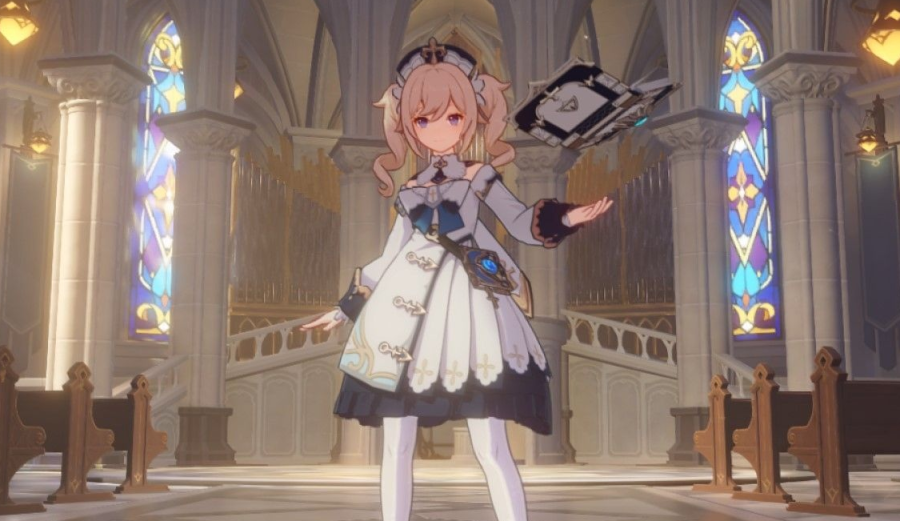
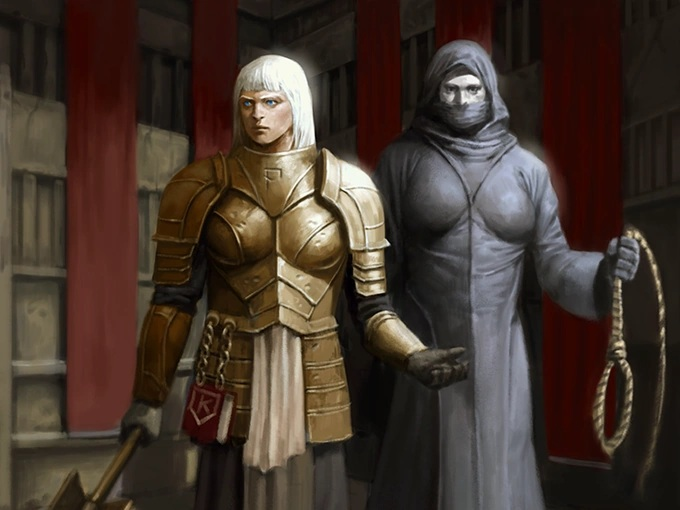
When you tried to answer that question, you were likely struck with this problem: in that imaginary world, there’s nothing that we Christians would identify as something like “God.” Of course, there may be gods and goddesses of various kinds, good, bad, or even eldritch. And there’d be religions as well, and maybe even an institution called the “Church,” which will look suspiciously like Christianity in its appearances and organization—usually the Roman Catholic version. And often, these Catholic-like “Church” would be corrupt, ignorant, or violent, so much so that this is now a cliche. Yet oddly enough, even such “Church” will likely lack any belief in something that we would call “God” by any stretch of imagination: Creator and Sustainer, Infinite, Eternal, One, and Good—let alone “Christ-like” in love and sacrifice.
And that’s odd.
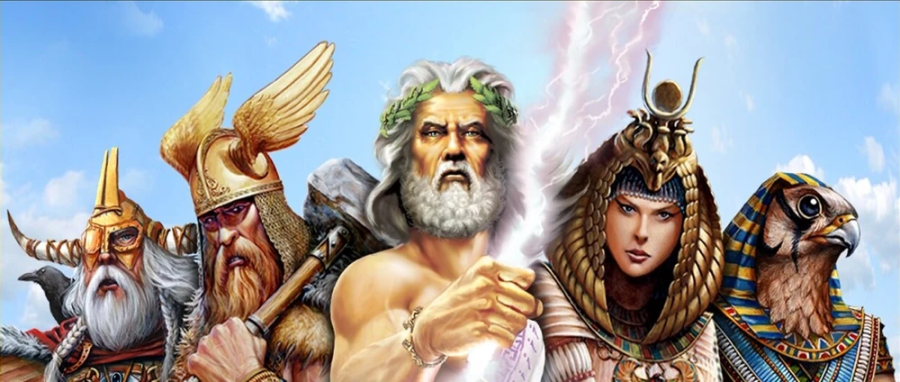
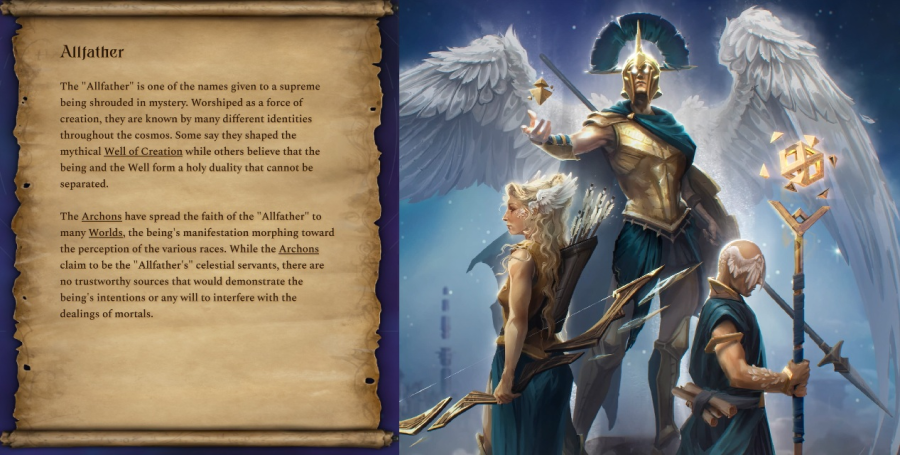
I realized how odd it is as I was recently playing Age of Wonders 4. In the setting of the Age of Wonders series, there are beings called the Archons, a cosmos-faring angelic beings, who’ve taught the other races about the “Allfather,” the Creator who “pulled the cosmos” forth from the “Well of Creation.” Of course, what these Archons teach about the “Allfather” is openly questioned in-game. Then again, these Archons are the most ancient beings in the cosmos; they’re also generally benevolent if dogmatic; and the “Well of Creation” is very real in-game, theorized by some as a manifestation of the “Allfather” himself. But either way, my point is that at least the belief is there. And as I was playing the game—which I enjoy immensely, btw—I was suddenly struck with how rare that is.
There have been so very few games—or movies, novels, or anime—in the last few decades where there’s even so much as a belief of such singular Creator-God. Off the top of my head, I can only think of the Dragon Age series, and possibly the indie tactical rpg, Symphony of War, and among the JRPGs, the Trails series (even if it features a Creator-Goddess).
And most of us have probably become so used to this, that we don’t give it a second thought. We may even wonder why I’d bring this up in the first place. After all, these are just imaginary worlds; of course they wouldn’t have the kind of belief we have in our real world. So why should we care whether some imaginary people in imaginary worlds have a belief that resembles our God? However, I beg—nay, demand—to differ! Because by that logic, why should an imaginary world have, well, humans like our real world? Why should it have the kind of architectures and arts and cultures similar to ours? And we all know that game-developers often go out of their way to represent people of every conceivable demographic, from race, culture, gender, to sexual orientation. And they often even have religions, which have all the trappings of Christianity, from chapels to cathedrals, masses to confessions, priests to bishops to popes, yet without anything that resembles the very beliefs that gave them birth!
However, my interest here is not to rant about the seeming absence of our God in our games. Remember what our thought-experiment was: say you found yourself in that world. How would you speak to them about your belief in God? In a world where they believe all sort of gods and goddesses, good, bad, and eldritch, yet nothing even remotely like the “God” we believe?
Because that was the question that confronted the early Christians, living in a pagan world; and it may actually be the question that we face today.
The Christian “God” in a world of “gods”
Have you ever imagined what it’d be like if we found ourselves in a Dungeons & Dragons type of world and became an adventurer there? I mean assuming we, frail and pampered-by-modern-amenities as we are, manage to survive a world with dragons? Here’s a question: say a cleric in your party found you praying one day—I’d be praying if the occupational hazard of my day-job was becoming a bite-sized dragon-snack—and she asks, which deity you were praying to. What would you say?
I’d imagine we’d do either of the following. Lie and say something like, “Ba’al! I mean Bhaal, no I mean Mystra!” Or, we’d own up and say that we don’t believe in any of the gods in her pantheon, and then introduce a completely foreign deity she never heard of. And hope she’s the kind of cleric who’s very tolerant, because in her eyes, we’d be a cultist, or an atheist, or both.
Yet, that’s how early Christians were regarded historically; it’s why they were persecuted so harshly by the Roman Empire. They were believed to be part of a new cult, sowing chaos and seeking to overthrow society. And worse, they seemed to be “atheists.” After all, they disbelieved all of the gods worshiped throughout the Empire.
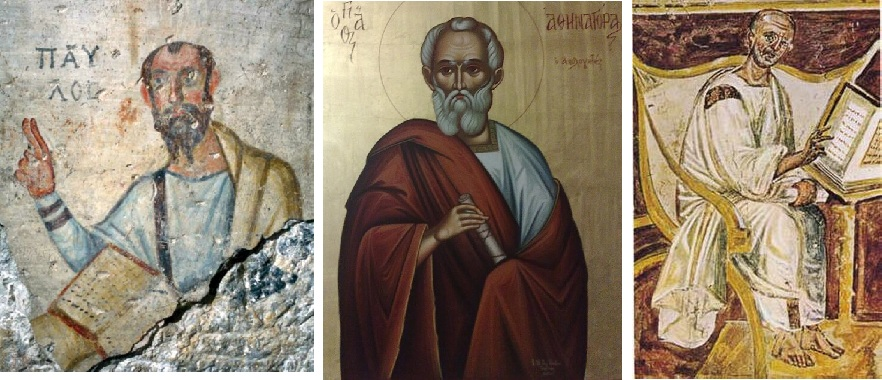
There’s a fascinating work written during that time, by a man named Athenagoras, addressed to the Roman Emperor and his heir. This letter, titled “A Plea for the Christians,” explains that Christians are not atheists because they worship the God who created all things, whose Spirit leads them to godly, peaceful living—rather than say, eating babies (yep, that literally was one accusation). But Athenagoras goes on to say something more than just that only the Christian “god”—the “god” of Israel and Jesus—is real. In the middle of his work, he makes this interesting pivot, by quoting pagan poets and philosophers, arguing that they all believed in something that’s more and beyond their gods: the Source of all things and the Standard of all goodness, even though they called that Source by different names.
So, while there was no specific religious belief among the pagan Romans regarding the singular and good Creator-God, there was still something foundational to their world, which Athenagoras identified as the Christian “God.” That is, instead of introducing “God” as some foreign, cult-like idea to his readers, he pointed to something in their world and then showed that that was God.
And he was not alone in this approach. Apostle Paul does something similar in Acts 17:22-31—which arguably is the sole example in the Bible where Christian beliefs are presented to a purely pagan audience. He begins by saying he’ll speak about an “unknown god,” but then pivots to say that the God who is the Creator and Lord of the cosmos is the One that their own pagan poets have been singing about. And a few hundred years later, a Church father named Augustine remarked that even before he became a Christian, pagan philosophers had been teaching him the opening line of the Gospel of John: In the beginning was the Logos, the Logos was with God and is God, and everything came into being through him.
And this brings us back to why I asked that question about our games.
What our Imaginary worlds of games present
An imaginary world we become immersed with, its characters we come to know and care about—these aren’t just some figments. As we learn their stories and follow their journeys, their struggles and triumphs, we essentially come to simulate their lives in our heads. I mean that feels kinda intuitively true; good stories move us to see things from the eyes of its characters. But this also happens to be the findings from the studies into our brains; when we read, watch, or play through, these stories, the areas of our brain activates as if we’re going through the same things. So, for example, as we follow them running frantically through a dark forest, chased by ravenous ghouls, the areas of our brain associated with running, emotions of fear and such, light up. And this becomes especially true when playing games, because there we don’t just follow a story; we become part of how it unfolds.
That means, by the time we come to know and care about the game’s characters and become immersed in their world, we’ve been simulating our relationship with them. Such games place us in their world in a way that best-equip us to speak about our faith to them. Because we know the life they lived, paths they walked, hopes they yearn; we know their whole world—often better than they do. If Athenagoras and Augustine and the Apostle Paul was able to speak about God to their pagan world, so can we in this simulated world, and do so in a powerful and persuasive way.
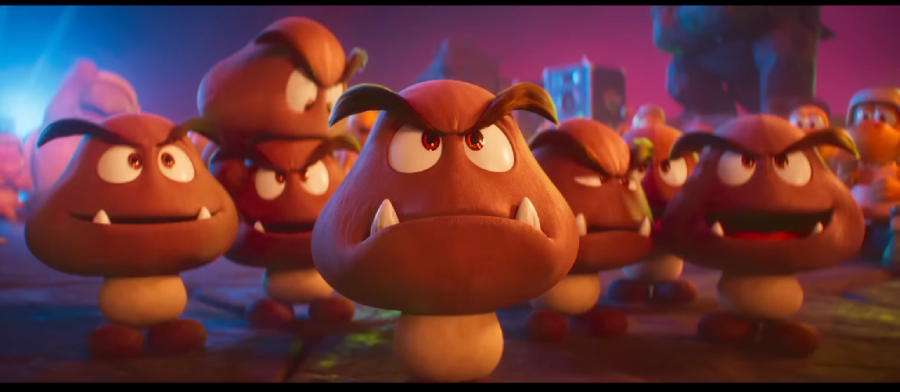
Nor is our thought-experiment some idle what-if question. Our world is one where for many, many people, our Christian “God” seems nowhere to be found—an absent entity, as unbelievable as UFOs. Instead, they follow many other “gods,” good, bad, and eldritch, though we now tend to call them, forces, principles, values, or ideologies. And such people then craft the imaginary worlds of the stories we read, shows we watch, and games we play—worlds that reflect their own. And we who speak into that world must find and point to “God,” Who is there, just as He is here, as well as even in our games.
“It’s as easy as that!” Ok, no, not really.
But all that’s easier said than done. How do we do that? And what would it look like? Well, for starters, I’ve written a book trying to do just that for our “Godless world”—yes, this is a shameless plug!
Still, we’ve got some ways yet to go in finding “God” in our Game-world. Because it turns out that there’s a fair reason why games wouldn’t want God-with-a-capital-G to appear in their stories. So, in my next article, we’ll begin with that, then explore how games that did include “God” deals with this problem. And then, how the grand-daddy of our modern fantasy worlds wrestled with the Christian idea of God—yes, I’m speaking about J.R.R. Tolkien’s Lord of the Rings—and what that means for our world.
So, please stay tuned!