
Overview
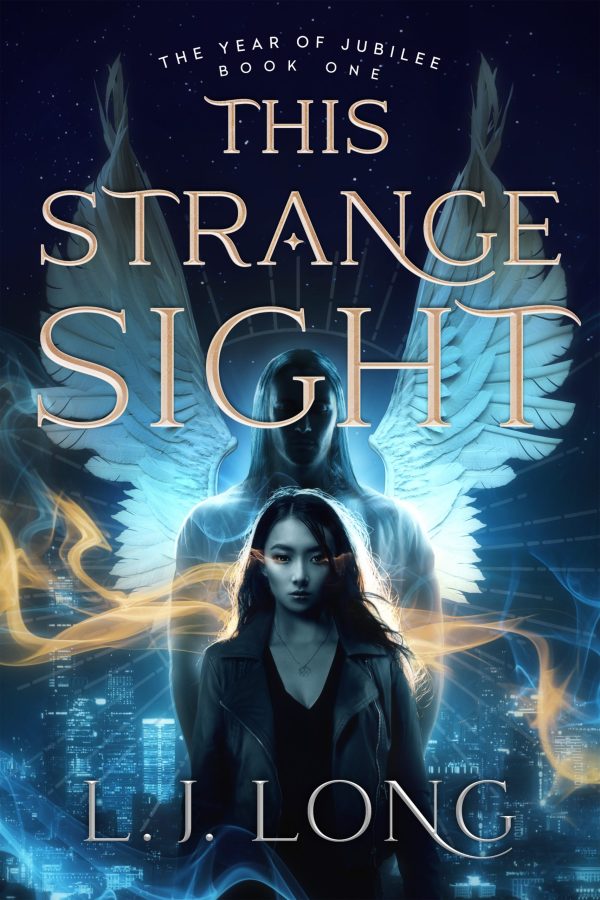
| Synopsis | Whilst starting a new life in Beijing, a young woman with the ability to see the spiritual realm becomes involved in an investigation suspecting a girl and a demon. |
| Author | L.J. Long |
| Publisher | LJ Long Story |
| Genre | Christian Fiction, Urban Fantasy, Mystery Thriller |
| Length | 356 pages |
| Release Date | June 1st, 2026 |
This Strange Sight is author L.J. Long’s debut novel. Pulling inspiration from C.S. Lewis’s The Screwtape Letters, Frank Peretti’s This Present Darkness, and Tsugumi Ohba’s Death Note, Long creates a new and engaging narrative that takes readers into modern Beijing from the perspective of a woman who can see angels and demons.
Content Guide
Violence/Scary Images: There are references and depictions of self-harm, abuse, and suicide. There is a car accident described in a flashback. A character experiences the feeling of going to hell, which can be disturbing for readers.
Drug/Alcohol References: A character reflects on their past that included clubbing and copious amounts of alcohol. There is a scene that includes a drinking contest. A character is suspected of dealing drugs. At one point, a character is drugged at a club.
Sexual Content: While nothing is graphic or detailed, sex and sexual assault are referenced.
Spiritual Content: Angels and demons are characters. There are depictions of the spiritual realm, including heaven and hell. Characters discuss Biblical themes and verses. The book and its narrative are written from a faith-based perspective.
Positive Content: Biblical forgiveness and redemption are the main themes of this novel.
Review
Upon receiving This Strange Sight (generously provided to me via an ARC copy – thanks to the author!), I was immediately curious over the premise and promises. This is an urban fantasy novel set in modern day Beijing and features a murder mystery, a supernatural look into the spiritual realm, and a slow-burn romance. How does the book handle all of these topics, and from a faith-based perspective? Let’s talk about it!
The glue that makes this book stick together is the excellently written characters. To start, Jubilee is a real piece of work (and she knows it). She has made a lot of mistakes. And not small, petty mistakes… I’m talking about mistakes that significantly and negatively impacted her life and the lives of others. Yet, she’s the one gifted with the titular sight that reveals the spiritual realm of angels and demons. Not because she’s part of some magical bloodline or as a reward for being pure or innocent (like I see in many modern fantasies), but rather as a tool to guide her towards redemption. The personal journey Jubilee takes throughout the book is one that is both compelling and frustratingly realistic. Many times I found myself confused as to why Jubilee handled certain situations in the way that she did, but had to ask myself, would I really do any better? I think all of us can relate to Jubilee in some way, and I appreciated how fleshed-out she was overall.
The other main characters that I wanted to highlight are Zheng Yi and Graeson Law. Zheng Yi acts as a foil to Jubilee — someone whose righteous desires lead her down a dark path. She becomes an antagonist in the story, yet I still found myself wanting the best for her. I loved the tension of knowing what Zheng Yi was up to while our protagonists tried to put the pieces together. The secondary protagonist, Graeson Law, is a machine of a man who will do anything to solve the case that has been put in front of him. The dynamic between Law and Jubilee is charming, and I’m eager to see more of the duo in the sequel!
Themes and Critiques
It’s hard not to see the heavy inspiration from Death Note in This Strange Sight. Zheng Yi makes a deal with a demon akin to Light obtaining the titular Death Note. Both characters have demon-like beings following them as they use newfound power for their self-proclaimed justice. Law also operates similarly to L, being the mastermind investigator determined to solve the case. But there are some crucial differences. For one, while Light and L are perfect foils of each other in Death Note, Jubilee and Zheng Yi serve as the tension-filled relationship rather than Law and Zheng Yi. This is important, because the tension between Jubilee and Zheng Yi revolves around their conflicting ideas of justice and redemption. They are similar characters in so many ways, and I could feel Jubilee’s desperation to turn Zheng Yi away from the path of darkness, a path that she is far too familiar with.
The other important difference between Death Note and This Strange Sight is in their themes. Death Note is a case study of human nature at its core. The manga ponders and demonstrates what would happen if one person was given godlike power. The supernatural beings in the manga do not influence the characters, but simply observe with great curiosity. This Strange Sight, on the other hand, proposes the idea that humans are influenced constantly by forces outside of our control. We are able to see this through the eyes of Jubilee, who watches angels and demons subtly influencing humans in their daily lives. This take on spiritual warfare is not action-packed and dramatic like you might find in books like Cassandra Clare’s The Mortal Instruments series, but more so reminiscent of C.S. Lewis’s The Screwtape Letters, emphasizing how daily decisions can lead people down the path of light or darkness.
Speaking of angels and demons, I would have loved to see more of them! Hellenos is Jubilee’s guardian angel, but I was somewhat disappointed in the lack of interactions between them. It is so rare to see depictions of guardian angels in adult-oriented media, and with how fleshed out every other main character was in the book, I wish that Hellenos got the same treatment. Even the main demon of the book had a defined personality and backstory! Perhaps we will see more of Hellenos and other guardian angels in the sequel. I would also love to see more reflection of Jubilee’s identity in the sequel. There is so much opportunity to explore the experience of being an American-born Chinese woman living in Beijing, and this book only scratches the surface.
Conclusion
This Strange Sight aims high and swings hard. And, for the most part, it hits the mark on what it sets out to do. If you like following well-written characters, exploring themes of justice and redemption, and a banter-filled budding romance on the side, then you are in for a treat! Just be aware that while this is a faith-based book, it is not family friendly. I strongly encourage anyone interested in this book to carefully heed the contents written above. Some content may be triggering for some readers. But as for me, I am looking forward to the sequel! As time passes, I still ponder over some of its themes. How far can we go in the name of justice? How do angels and demons affect our lives when we aren’t paying attention? And if Jesus loved Jubilee in her deeply sinful condition enough to save her, what does that mean for Zheng Yi? For Law? For me? For you?
Positives
+ Realistic and endearing main characters
+ Quick pace keeps readers engaged
+ Positive depictions of God, Christianity, and Scripture
Negatives
- Wanted to see more characterization in the guardian angels
- The ending directly prompts the sequel, leaving many things unresolved
- Mature content may catch readers off guard
The Bottom Line
This captivating novel utilizes well-written leads and the unique concept of the spiritual realm to make me ponder not only about the fates of the characters, but more importantly, about how spiritual warfare can influence my own life and the lives of others.
| Story/Plot | 9 |
| Writing | 8 |
| Editing | 7 |