
Overview
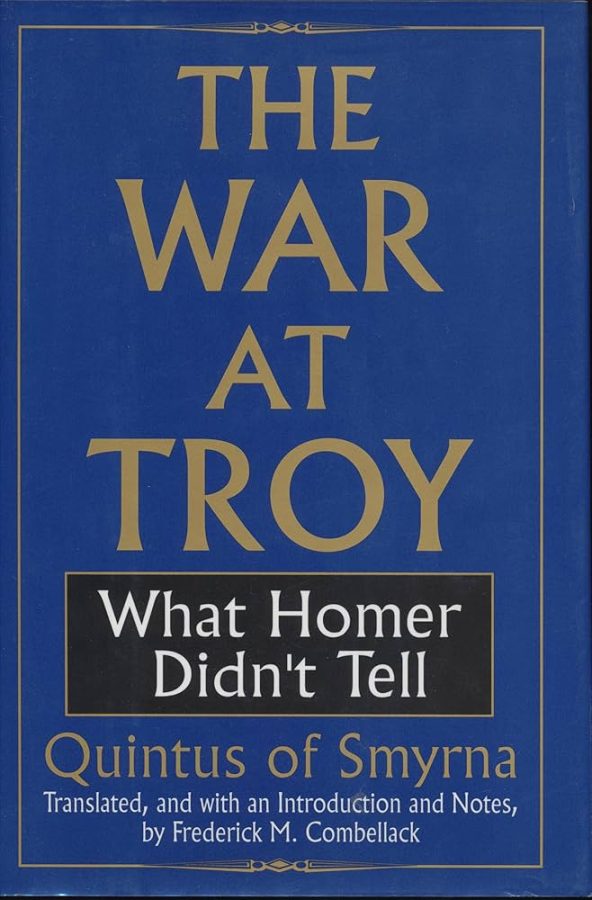
| Synopsis | Set between The Illiad and The Odyssey, Greek warriors continue to besiege the walled city of Troy to rescue Helen and avenge their fallen warriors. |
| Author | Quintus of Smyrna, Translated by Frederick M. Combellack |
| Publisher | Barnes and Noble Books |
| Genre | Poetry |
| Length | 279 Pages |
| Release Date | January 1, 1996 |
Last year, I had the privilege of reading Hesiod at a beautiful Japanese meditation garden in Rockford, IL. In that moment of peace, I interacted with the Greek poet in near total silence and serenity. Even then, his words were dense, flowing over the eyes slowly and in hefty chunks, hardy to digest. Hesoid is hardly conventional or easy poetry, but that is to be expected. His two famous works — Theogony and Works and Days — are strange to modern eyes and clunky, even if they are short poems. They’re hardly relaxing, but terse and tense reflections on morality and the gods.
Such is the nature of the Ancient Greeks. They were brilliant but utterly alien to modern Christian eyes. Reading them is to read into the virtues and horrors of the pre-Christian world. I previously read through The Illiad, The Odyssey, and The Aeneid for review here at Geeks Under Grace. But with the upcoming release of Christopher Nolan’s Odyssey this month, I wanted to delve into this world once again, and chose to do so with a more eclectic work of Greek mythology — The Posthomerica. Or as it is called in the translation I read, The War at Troy: What Homer Didn’t Tell.
Content Guide
Violence/Scary Images: Frequent violence, descriptions of gore, and poetic explorations of war, slavery, and death.
Language/Crude Humor: Limited to none.
Drug/Alcohol References: Characters frequently drink alcohol to excess to celebrate their victories.
Sexual Content: References to marital sexuality, as well as implications of women being kidnapped to be used as sex slaves.
Spiritual Content: The story explores the interactions of the Greek gods with the world of the living, as well as describing the Hellenic afterlife in passing.
Other Negative Content: Themes of Pagan virtue and intense descriptions of war.
Positive Content: Themes of virtue, love, family, and honor.
Review
Quintus of Smyrna is not a poet who is widely discussed or regarded in the Western canon. Indeed, he doesn’t seem to be well remembered by history. The mysterious fourth century poet — a likely Roman citizen living in modern-day Turkey — is only known today for his epic poem Posthomerica, an untitled epic poem that functions as an interquel between The Illiad and The Odyssey.
Quintus doesn’t appear to have held any special knowledge of the true history of the Trojan War, given that he lived thousands of years after the alleged mythological conflict. He wasn’t even the first Hellenic poet to write about this time period. As the YouTuber Overly Sarcastic points out in the above clip, Quintus is just one member of an entire tradition of Homer fans who attempted to engage within a greater tradition of epic storytelling. If anything, he’s a latecomer to the phenomenon, given that prehistoric Greek poets like Lesches and Arctinus wrote poems that covered the same time period in the 7th and 8th centuries BC. As far as we know Quintus at all, he was an imitator of greater poets.
Going off Frederick M. Combellack’s 1968 prose translation (or the 1996 Barnes & Noble Books edition of The War at Troy I own), it is also notable how derivative the poem is of the great works of Homer and Virgil. Combellack notes in the poem’s introduction that his attempt to copy Homer’s style is stylistically “abrupt” and “lazily” organized, with shallower characters and an episodic structure, making many creative decisions that are decidedly “unHomeric”. Unlike Homer’s great poems, Quintus doesn’t even assign a unifying theme or moral to his work.
However, it must be said that The Posthomerica is a remarkable poem in its own right. Despite its derivation, it succeeds in a number of ways. For one, it has actually survived nearly 1,700 years. This is a feat most ancient manuscripts failed to do, meaning generations of poets have viewed Quintus as an essential part of the Homeric tradition. Secondly, Quintus is a remarkable poet in his own right. Just because he isn’t Homer, that doesn’t mean he is bad. There’s a long qualitative drop from Homer to unreadably bad.
Story and Structure
Indeed, my primary takeaway from the poem was how much it was able to deeply invest me into characters and conflicts that sounded dull from the outset. The poem introduces dozens of new characters on both sides of the Trojan War to fill its 14 books worth of space. Despite going into it with unclear expectations, I came away from the poem with names like Aias, Penthesileia, Eurypylus, and Neoptolemus having surprising staying power.
The structure of the poem comes in waves of fate and turning tides, with the flow of battle shifting between Greeks and Trojans minute to minute. The structure is thin. Set late into the Trojan War, both sides have already played their best cards. The Trojan hero Hector is dead. Calls for help have been sent in all directions by both sides. Changes in fate are thus the result of new warriors showing up out of the blue, either shifting the flow of battle or being quickly defeated by godlike warriors.
If there is a major instigating event, it is the death of Achilles relatively early in the poem, which facilitates the Trojans’ triumphalist resurgence by proving to them that they have a chance at victory. Having been killed by Apollo and carried to the Elysian afterlife, the Greeks are left reeling with the very real possibility that the Trojans could overwhelm them, burn their ships, and massacre their remaining forces. Similarly, the Trojans despair at the possibility of their young men being slaughtered and their women being carried off as slaves. From here on out, the poem slowly covers the continued shifting of the conflict as it leads to the events of the Trojan Horse, the Sack of Troy, and the Greeks’ final departure.
Much like The Illiad, the body text is poetic descriptions of war. Battles have vivid detail and harsh descriptions of gore: bodies being crushed, bones crunched, souls departing material bodies, carnage spread across fields, and spirits descending to eternal torment in Hades. Almost every death is punctuated with that person’s name, highlighting the personal tragedy of almost every death on both sides of the war.
Horror and Catharsis
The palpable tone of tragedy and grotesquery that hangs so well off The Illiad returns here, a clear indication that Quintus understood the assignment he was undertaking. As I pointed out a few years ago in a review of Homer: The Very Idea, the true value of Homer’s poems is that they spoke to some forgotten moment of true horror and depravation that struck humanity in the midst of the Bronze Age. The Trojan War probably didn’t happen as described, but it has become a secular stand-in for something like the Edenic Fall.
“Homer’s works do seem to allude to a deeper horror that is based on true events. The Illiad and The Odyssey were likely works of the late Bronze Age or Early Iron Age, a time when the civilizations of the Mediterranean experienced a civilizational collapse and descended into a dark age. This ‘systems collapse’ occurred around 1200 BC, in the vicinity of when the supposed Trojan War was suggested to have happened … The truth of Homer’s work is not merely that it captures the history of a forgotten war but that it may express the trauma of a mysterious moment in human civilization, a dark age, ‘unfathomable except as a myth about the end of a mythical time itself.”
This sense of dire finality and brutality is palpable throughout Quintus’s poem, culminating in the brutal sacking of Troy. Bodies are broken. Women are treated as prizes. The gods themselves bury the remains of the great city to wipe the very disaster off the face of the earth.
Quintus not only delivers on this dire tone but fills in the blanks with brilliant little moments of commentary and catharsis. Among my favorites are a pair of interactions shared by both sides of the battle. Amid the stalemate, leaders on both sides of the war ask the very modern and utilitarian question of whether the war is worth it at all. Maybe the Greeks should just go home and give up the endless siege? Maybe the Trojans should release Helen of Troy and sue for peace? However, both armies’ leaders castigate these questions as cowardly, unbecoming of a proud Bronze Age warrior. There is more than lives on the line. These warriors must defend their honor and make names for themselves, as they were “full of enthusiasm for ruinous war.” They run to their brutal doom with glee.
“It is better to die a quick and glorious death fighting for our country than to stay inside the walls and die with suffering,”
– Aeneas.
There is tremendous weight to Quintus’s poetry that comes through even in my prose edition. Death and doom pervade the story, as equally as the virtues and bravery of these warriors as they march into battle. Every death is treated with the depth it serves. The victory of the Greeks, though cathartic, doesn’t downplay the despair of the Trojans as they welcome a swift death to silence their pain, loss, and grief. Helen’s lament for Paris captures this depth well:
“My husband, you were a great disaster to me, to the Trojans and to yourself, and now you have died miserably. You have left me in the midst of loathsome evil, expecting to see still worse disasters … Everyone shudders at me beyond telling; everybody hates my heart, and I know of no place where I can find refuge. If I run away to the crowd of Greeks, they will immediately outrage my body. If I stay here, Trojan women and Trojan men will surround me on all sides and quickly destroy me. And no earth will cover my corpse, but the dogs will tear it, and the swift tribes of birds. How I wish that Fate had killed me, before I saw these disasters.”
A nymph, overseeing the scene, offers deeper commentary, calling Paris “a wicked man. He abandoned the noble wife of his youth and took a wanton to his bed, bringing grim pain to himself and the Trojans and his city.” Even as all this is said, Paris’s father Prium still laments that his heart and soul have been destroyed with the death of his children in battle, ultimately begging Achilles’ son to slay him and end his pain. Such is the story that in each small death, even for wicked characters, is a “sorrow upon sorrows, inescapable forever.”
There is a real catharsis to the poem, though, that comes with the dawn after Troy’s sack. The death and desolation finally end. Helen’s husband Menelaus is overcome in the heat of battle by an “unexpected amazement” brought on by the will of Aphrodite, after he attempts to slay the woman he sieged the city to save. “Lost in wonder,” he is unable to kill his estranged wife and embraces her after the battle, saying “Think of these things no more now, but check the sorrows in your heart. I hope the black hall of forgetfulness may shut all this somewhere deep within. It is not proper to remember evil things any longer.” And in this line, the disorder of lust and war is forgiven in the tears of love.
Imitation and The Poetic Tradition
I wish to impress that Quintus is, in many regards, essential and underrated. Not only is it a brilliant view into the minds of the cultures that received Homer, but a valuable look into the story of the Trojan War itself. For fans, this is the essential narrative territory that those original stories only mentioned in passing.
Particularly given how rare ancient surviving poems are, a poem like this is a treasure. It provides deep insight into the way that the ancient Greeks and Romans alike found meaning and identity, in this ancient poem that predated the works of Plato and Aristotle by 400 years.
Indeed, it is a tradition that continues. Homeric imitation is an art we see echoed throughout literary history to today, through the works of Chaucer and Shakespeare to recent LGBT-inspired and feminist-tinged works like The Song of Achilles and Circe. At the same time, Homer is still big enough to have haters. Incidents of school teachers attempting to remove The Odyssey from their curriculums have become national news stories. Even somewhat controversial translations, like the recent Emily Wilson translation, are deeply in dialog with the original poem. We wouldn’t be receiving a Christopher Nolan rendition of the story without these dialogs working in a greater tradition of imitation and commentary.
Everyone has an opinion about Homer. He cannot be escaped. He can be imitated, he can be canceled, he can be abused, he can be neglected and ignored, but he haunts the Western mind. In that sense, Quintus may well be the truest essence of the saying that imitation is flattery.
Positives
+ Beautiful Poetic Descriptions
+ Fascinating New Homeric Characters
+ Potent Tone and Catharsis
Negatives
- Lacking Central Theme
- Overall Lacking Compared to Homer and Virgil
The Bottom Line
Quintus isn't as essential reading as Homer, but he is a great ancient poet in his own right who fills in the story gaps between the two great works of Greek literature with panache and powerful poetry.
| Story/Plot | 8 |
| Writing | 9 |
| Editing | 7 |