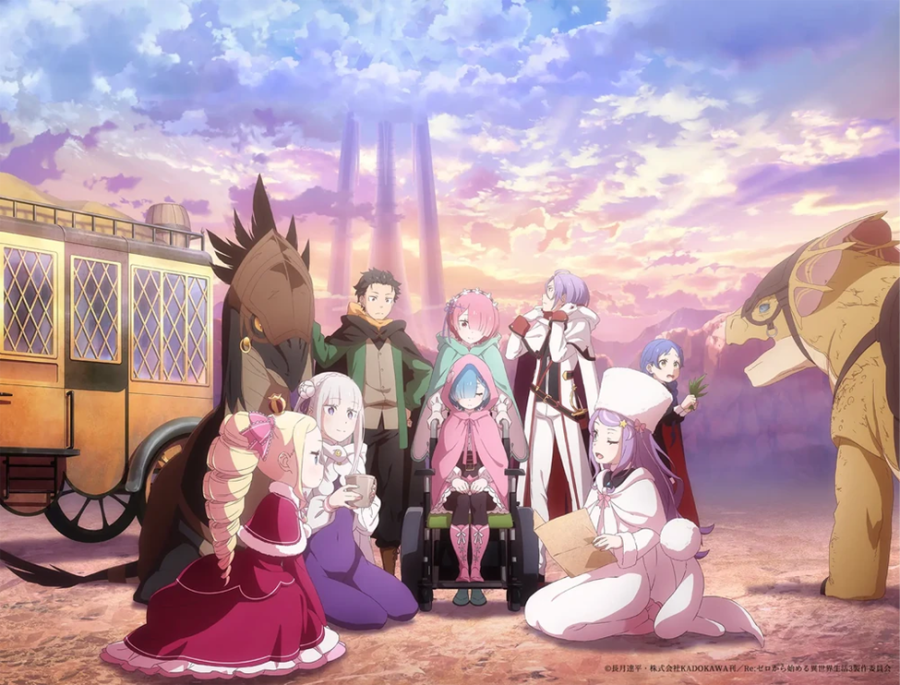
With the season four of Re:Zero now well underway (at the point of this writing), I wanted to ask an odd question: Why does Rem remain such a popular and beloved character among the fans of the series?
First, a brief description for those not in the know. Re:Zero is an anime series — one of the most popular and widely known — based on a Japanese light novel series titled Re:Zero − Starting Life in Another World. It follows the story of Natsuki Subaru (given name is Subaru, but I’m keeping the Japanese order), a high school shut-in, who is transported to a fantasy world. The distinct feature of this series is the painful realism in portraying how Subaru — a well-meaning but inept teenager — fares in a dangerous world. Which is to say, he’s brutally killed before the first day ends. But surprise! Subaru finds himself alive again, a few hours before his death. That’s his secret special ability in this “another” world: whenever he’s killed, the world apparently “rewinds” to a specific time before his death, and he has to try again. And again. And again. And again.
There’s a reason why Subaru’s nickname among fans is “Sufferu.”
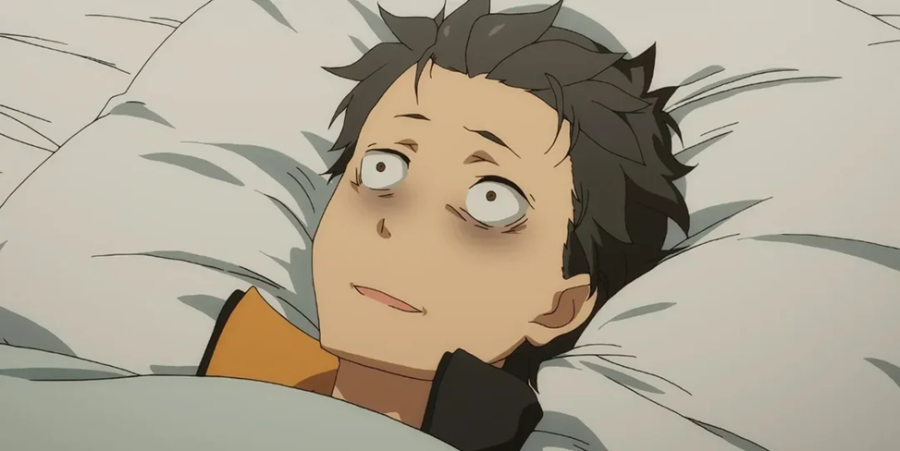
Now then, the rest of this article will assume that you’ve watched at least the first season of Re:Zero anime (or read the novels). Actually, there will be major spoilers regarding one key character — Rem. Fair warning: those who want to avoid them, turn back now!
Or watch the series first, then come back. I can wait. Which is to say, this block of text can wait, since I’ll be doing other stuff by the time you’re reading this.
Unless you’re like me and you devour spoilers like T-Rex devour spoiled dinosaurs.
Either way, I’m going to go ahead.
How I Started Watching Re:Zero Because of Rem
I often seek out spoilers to shows I don’t intend to follow. That is how I originally came across Re:Zero. Before I watched a single episode, I already spoiled myself on what was going to happen… on its eighteenth episode.
See, before the anime series started, people were talking about this upcoming Re:Zero thing. And you know how it is while you’re browsing idly through some pop-culture wiki. Sometimes you click on a link without thinking because a word or two catches your eye. I don’t even remember what caught mine, but I clicked on a newly updated page on an anime character named “Rem.” It showed me a section that transcribed the conversation between Subaru and Rem, one that would be placed in episode 18 of season one. You know, the one with that particular line, which is the very basis of the series title: “Let us start here. From square one…. No. From zero!”
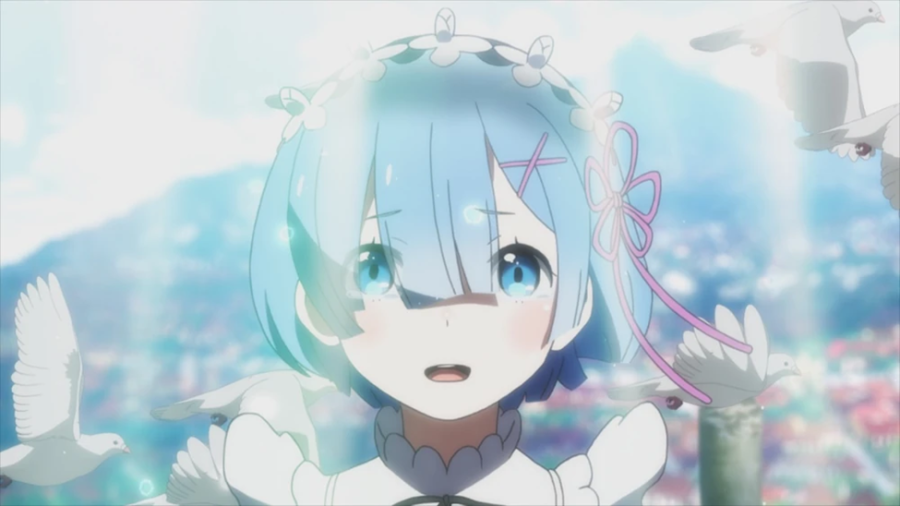
Reading their conversation is what led me to check out the series in the first place. And I would say that conversation is the reason for the strange popularity of the character, Rem.
But I’ve gone way ahead of myself. Who is Rem? And why do I say her popularity is strange?
The Strange Case of Rem’s Popularity
I did say I’m going to assume that you’ve watched the anime, at least up to the end of the first season. So, let me just remind you how this character, Rem, was introduced to us.
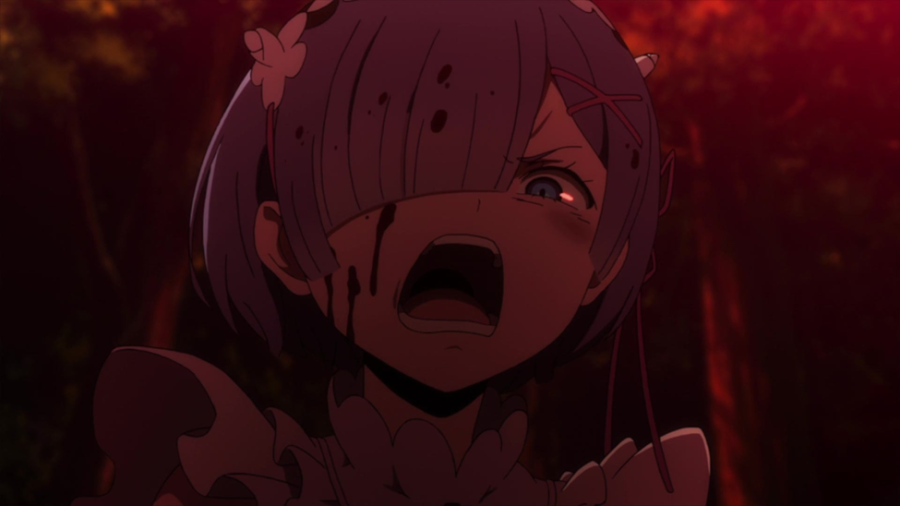
Whoa! Ok, that isn’t exactly the first scene she appears. Lest we forget, this character tortured, maimed, and killed the main character on at least two occasions in the story arc she was introduced. Yes, it was a misunderstanding. And yes, Subaru’s actions would’ve looked very, very suspicious from her point of view. But I’m simply pointing out that from the first several episodes we see her, we wouldn’t have pegged her as a heroine of the story, let alone the clear fan-favorite of the series.
She’s not just the most popular Re:Zero character, but is simply one of the most beloved characters in recent anime history, winning poll after poll and contest after contest. And this popularity seems to cut across cultures, languages, and countries: in Asia, Americas, and Europe — and presumably Africa (I couldn’t find poll results there). To get a feel for just how popular she is, when she won the “Best Girl” contest at Crunchyroll, she raked in 60% of the votes, with the second place at a distant, distant 15%! Going through the list of her winnings and rankings is like reading the resume of a multiple Academy-award winning Hollywood superstar. And she’s supposed to be a supporting character. The actual heroine of Re:Zero, Emilia — who from the start has been just as wonderful and lovable, if you ask me — didn’t even make the final cut for the same contest.
So, just what happened that made her go from the “Die, Subaru, die” character to this?
From Antagonist to Lovable Supporting Character
Rem did become much more endearing as the series went on.
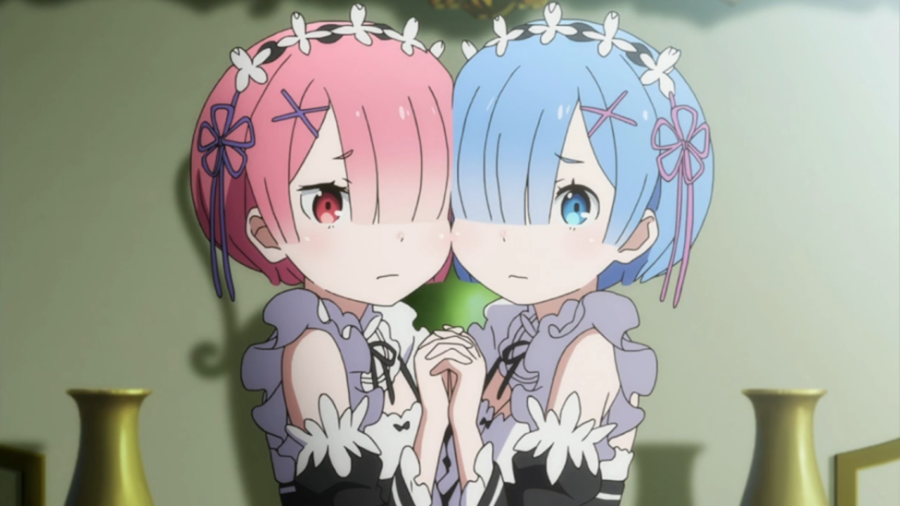
Getting to know her backstory definitely helped. First, everyone in her hometown, except her and her older twin sister Ram, were killed by the series’s primary antagonist, the Witch-Cult. Subaru’s rewind-when-killed power (yeah, I know it’s called “return-by-death”; I just like my wording more) marked him with the same “scent” of the Witch that the Cultists carried. And Subaru had been lurking around the mansion — so dangerously close to her beloved sister! — wafting that traumatizing scent. But Rem gained even bigger sympathy points from what followed. When she was young, Rem lived in the shadow of her sister Ram, who was considered a prodigy in almost everything she did. But during the Witch-Cult attack, Ram had been crippled protecting her. Ever since, Rem had desperately tried to be what she imagined her genius sister would have become. And always, always, failing at it.
This backstory made her turn-around that much more meaningful. After Subaru rescued her and the children from a nearby village from a demon-beast (never quite liked that translation btw), Rem opened up to him. She tearfully revealed her sense of inadequacy, of being the inferior copy of her sister. Subaru was someone from the outside, who was himself weak and powerless, yet heroically saved her when it counted. That means he could say that one thing she couldn’t accept hearing from anyone else: that she is not her sister’s shoddy replacement. She is a kind, hard-working, and loving sister — indeed, endowed with her own qualities. And he likes her just as she is. Her palpable show of relief as she released her burdens at his words remains a key moment in her story arc.
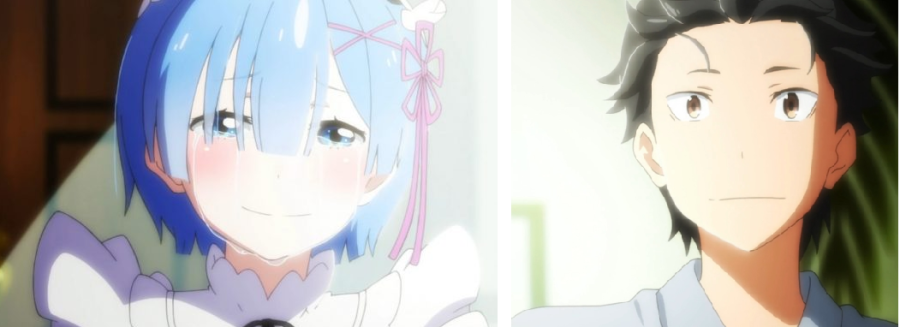
From then on, Rem becomes Subaru’s most ardent and loyal supporter. It was one of the most dramatic turnarounds I have seen. Rem went from someone who distrusted and sometimes even killed him, to someone willing to believe in him no matter what, and even die for him.
…That’s right. Die for him. Subaru, let me remind you, is called “Sufferu.” Dying for Subaru isn’t some extreme, hypothetical scenario; it’s Tuesday. If the days of the week went, Monday, Tuesday, Tuesday, Tuesday, Tuesday.
This was another way Rem steadily won over the fans. Right after this arc, Subaru meets a real foe: the Witch-Cult, led by the deranged “Archbishops of Sin.” They kill Emilia and pretty much everyone he met in the previous arc (except Roswaal, but of course, he doesn’t count). Then, there’s that eldritch Whale that devours the very existence of its victims, present and past. And when people he cares about needs him the most, Subaru… fails the most. He drives away everyone who could’ve helped or needed his help. All because of his ego, insecurity, and just outright ignorance. And because Rem is willing to die for Subaru, she does. Every. Single. Time.
Fans will often point at episode 15 as one that began turning Re:Zero from a fun series with a twist (oh look, Subaru died again) to one that leaves a mark. It’s where they — and Subaru — meet the story arc’s main villain, the Witch-Cult’s “Archbishop of Sloth” (who curiously is the very opposite of slothful). It’s where Subaru is chained to a wall, to helplessly watch as Rem desperately tries to rescue him and gets brutally murdered. It’s where after being left for dead, she drags her shattered body to Subaru, inch by inch, just to free him from his chains. And then, finally dies with an anguished declaration of love.
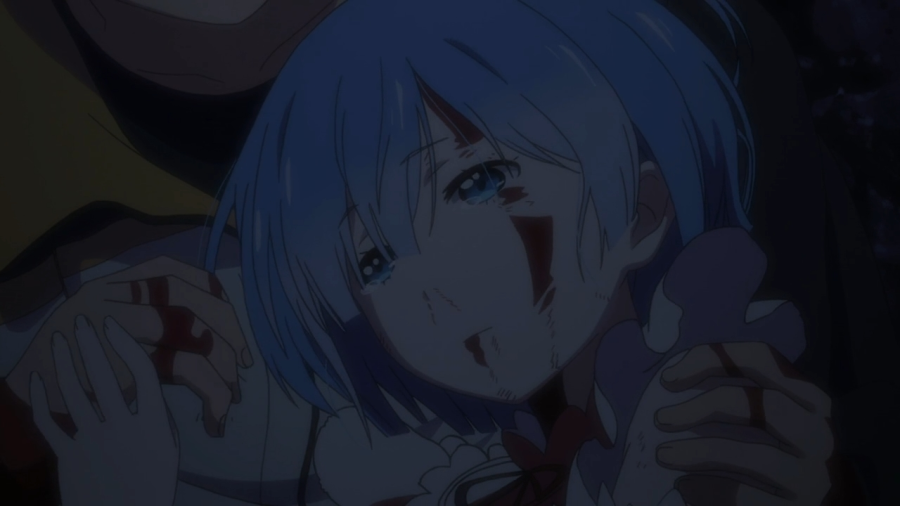
Oh and Subaru then unceremoniously gets his head lopped off, after being frozen solid.
Then Episode 18 Drops
Rem’s transformation in the course of Re:Zero‘s story explains why she’d win over the fans of the series. But it doesn’t explain the sheer scale and the feverish pitch of her popularity in its immediate aftermath. She was more than a well-liked character; her popularity was a kind of phenomenon. Some even call it a Cult, which isn’t entirely a hyperbole. The turning point was the episode 18. The very episode that I spoiled myself on and which made me watch the series in the first place.
The episode itself is a very strange one, considering its genre. Aside from a brief intro where Subaru gets killed again (it was Tuesday), the entirety of the episode consists of Subaru and Rem talking. A series that ran on a constant flow of mystery, violence, and death, devotes a whole episode on a conversation between two people. At the outset, it wouldn’t have seemed like an episode that is arguably considered the pinnacle of that season. But the content matters. Since you likely watched it by this point, let me remind you how that conversation opens.
Subaru basically gives up. He can’t solve this new crisis; he screwed up too much. He can’t save Emilia, the girl he fell in love with; he can’t save anyone. He wants to run away, but he’s too afraid to do so alone. But there’s Rem. The only one who hasn’t left his side. One who died for him. So he asks her to go with him.
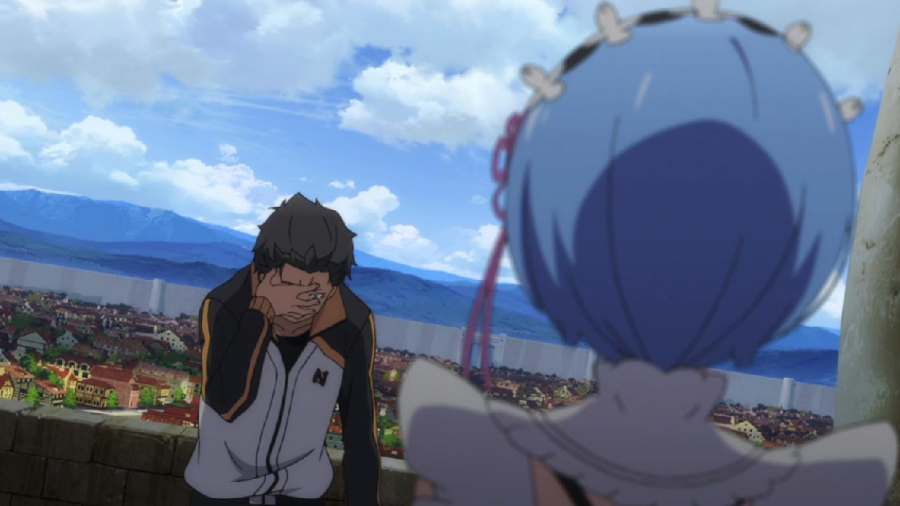
Rem answers his request by describing in haunting detail the kind of life she dreams of living if they were to run away together. But then she says no. Because Subaru is her hero, and she won’t abide — will never abide — him giving up. She doesn’t actually say that, but instead tries to encourage him gently. By gently, I mean like velvet covering over a granite mountain rock. Because Subaru explodes at her in response; and she simply faces him, silent and unmoved, listening.
What comes out of Subaru’s mouth is one of the most sobering things that those who watched this series would’ve heard. Because for the previous few episodes, the show had increasingly portrayed him, the main protagonist and the audience-surrogate, in a negative light. Subaru had started off as a slightly annoying but generally likable geek. He really did save those around him with his own clumsy, ham-fisted ways. However, over this story-arc, it’s revealed that underneath all that was an ugly sense of self-entitlement, jealousy, and a mix of inferiority complex and arrogance. The scene where all of that came spilling out as he spoke to Emilia would’ve been still fresh in people’s memory.
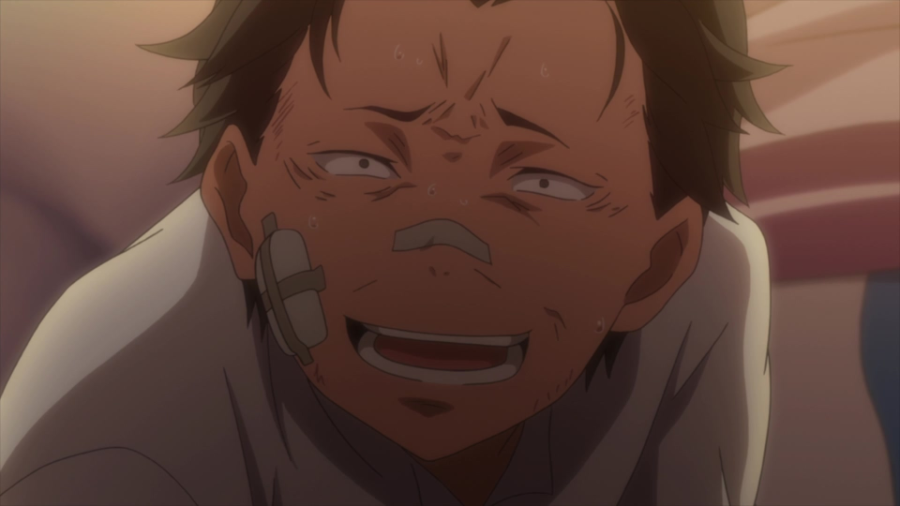
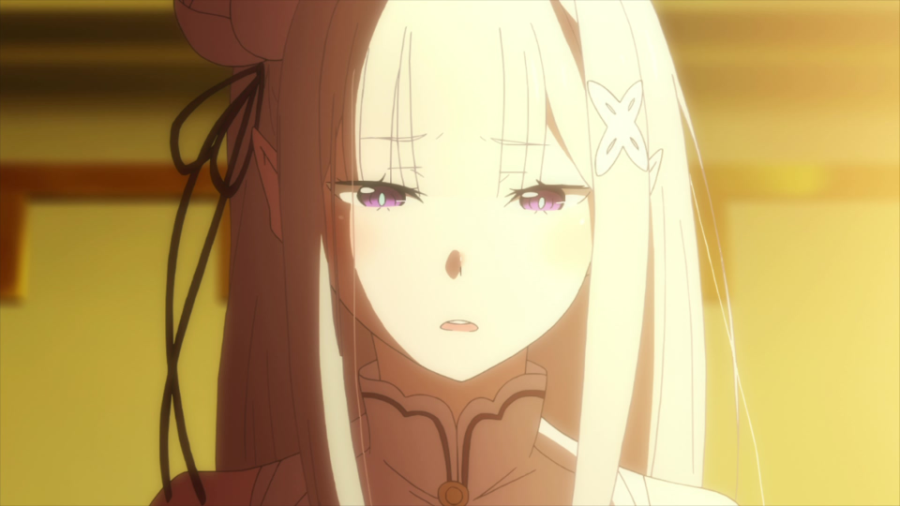
In episode 18, as he explodes at Rem, Subaru proceeds to name those very things that those watching Re:Zero would’ve come to dislike about him. But the thing is, many of those are also the kind of things we all hide in ourselves to some degree. Or as one reviewer put it, Subaru is the kind of audience-surrogate, “not as we would like to see ourselves, but as the awkward creatures we often wish we weren’t.”
The words he speaks to Rem also happen to be what most of us likely felt too, at least at some darker point in our lives: “What do you know? What do you know about me? … I hate myself!”
He goes on to confess, “Before I came here… do you have any idea what I did? I did nothing! …I had all that time, all that freedom. I could’ve done anything, but I never did a thing. And this is the result! What I am now is the result! All my powerlessness, all my incompetence, is the product of my rotten character!” Then, he finally vomits out the self-hatred he’d been hiding all along, “At heart, I’m just a small, cowardly, filthy piece of trash, who’s always worried about how others see me. And nothing — nothing — about me has changed! I knew it all along. That all of it was my fault. I’m the lowest of the low. I absolutely hate myself.”
Rem’s Response
What struck me when I first ran across this conversation is that Rem doesn’t deny what Subaru says. What she mostly says, at first, is the unimportant bits about him: his eyes, his hands, his fingers, how he sounds, how he sleeps, how he walks. Except that she loves them all. All those little things.
When Subaru dismisses that, saying he is unlovable, Rem finally explodes, “What do you know about the person I know?” You’re someone more than you think you are. A hero. Someone who saved me when no one else could. That’s why, she declares, “When no one else in the world believes in you, when you don’t even believe in yourself, I will believe! That the Subaru-kun who saved me is a true hero!”
But then, she does this odd thing. As Subaru murmurs in response all his fears and failings, she counters simply by saying that she is still here. With him. He’s empty and can’t do anything good, but she’s with him. No one wants to hear him out, but she does. He hates himself, but she loves him. “But if you cannot forgive yourself,” she finally says, “for being empty and having nothing. Then let’s start again from here, right now. From square one. No…. From Zero!”
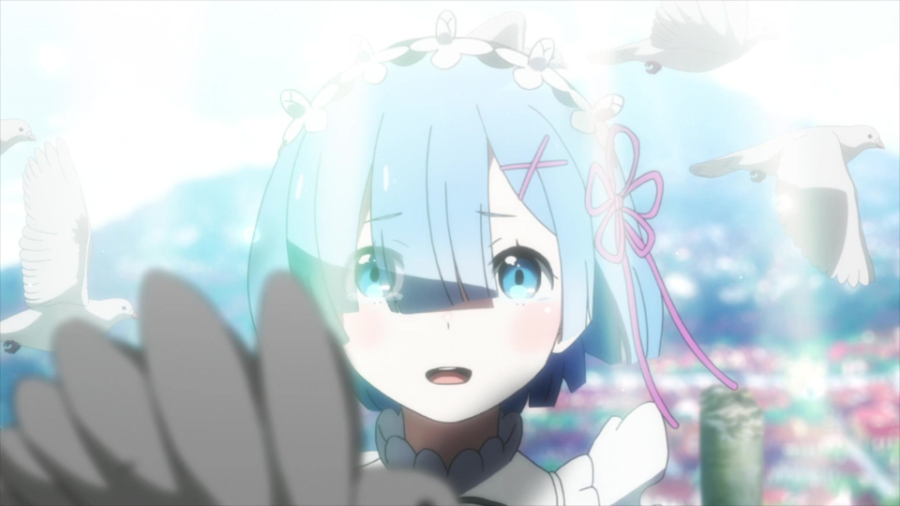
After literally summing up the theme of the series, Rem continues, “If it’s too hard for you to walk alone, I will hold you up. As we walk, we will share the burden and support each other.” Subaru won’t really be starting from zero; as always, she’ll be there for him, each and every step of the way. Until he becomes the hero she knows him to be.
Religious Archetype Conversation
We won’t go into that infamous answer by Subaru, “I love Emilia.” Because that’s beside the point. Other people can argue for or against the narrative merits of that line. As I said, I’m more interested in the strange popularity of Rem. Though perhaps not so strange for those who followed that episode. I want to point out something else about that conversation.
Firstly, the entire talk takes place in the ruin of an architecture, reminiscent of ancient Greek temples. All in pristine, aged, white marble. As Rem speaks the final lines to Subaru, a flock of white doves start flying past her. When she says those titular words — Let’s start here. From square one. No… from Zero — the camera is angled so that it gazes up to her, heavenward. And as you gaze up, sunlight shines down, almost blindingly so. There in that light, you see Rem, with her arms spread wide,her hands open toward the viewers. Almost like how the Christ the Redeemer statue in Rio de Janeiro would look for those approaching it, or like some religious vision.
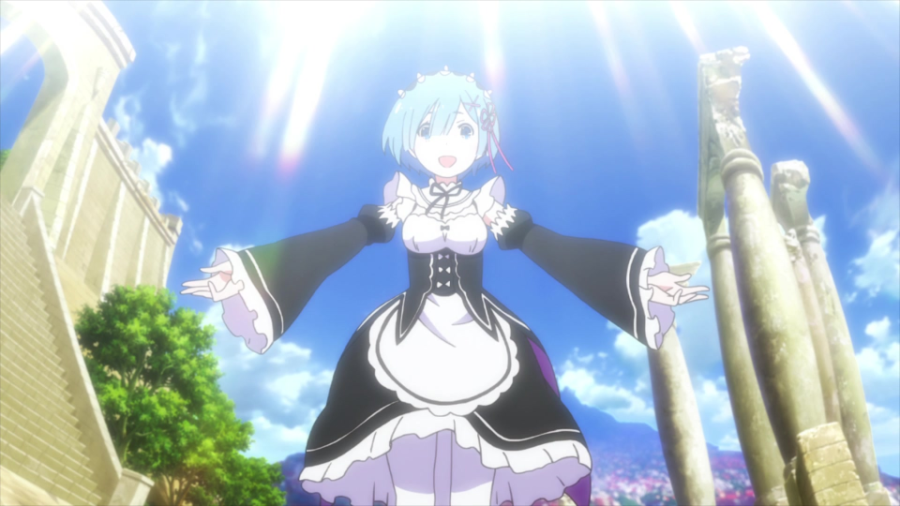
None of this is to say that Rem is written to be some Christ-figure, like Aslan in the Narnia series. Rather, I’m pointing out that, deliberately or not, the anime has woven Western religious symbolism into that entire conversation between Rem and Subaru. Her words and their impact were visually portrayed, not just as some romantic declaration of love, but as a kind of oracle or divine, prophetic message. The actual content of the conversation is even more significant, if we are willing to separate it for a moment from its immediate romantic context.
Subaru begins with a confession. Indeed, a confession of sins, which has the added bonus of being the kind that’d resonate with the show’s otaku audience. In fact, the confession is structured in the following: I have sinned, and this is what resulted. My faults, my failings, my character flaws, which I lied to myself about, led to this disaster; this is my judgement upon me. As I have written elsewhere, this very sense that we are somehow the reason for the broken world we live in, is something that haunts all of us — religious or secular. It is why even our so-called “modern” world will never fully dispel that old idea of sin and judgment.
This confession is woven with irrecoverable despair — that corrosive condemnation with no light to shine in that darkness. The only thing that gets through is the voice of grace. It listens silently through the hateful accusations he heaps upon himself — and meaningfully, in Christianity, the Devil is named Satan “the Accuser.” Then grace answers by saying, even if all of that’s true, I love you. Even if no one else, not even yourself, can love or accept you, I always have. And lest we forget, the one that says these words is the very person that has literally died for him — died because of what he did.
That voice doesn’t stop there. Because it says, you are not what you say you are. Or rather, that’s not all that you are. Even if you desperately want to give up on yourself, I will not let you. I will not abide in your self-hatred; I will not allow you to rot. I’m going to stay with you, push you, pull you through, step-by-every-step, until you become who I know you can be. A hero. You who can truly love yourself. Even if no one in the world will give you a chance. Even if you yourself won’t. Even if there really seems nothing that’s worthwhile in your life. I will start right there, with you. From Zero.
And if you are familiar with the Christian Gospel, you should know that that these are not Rem’s words.
They’re God’s.
The Theological Significance of Rem’s Popularity

After episode 18, the character of Rem became a cultural icon. Re:Zero merchandise that feature her image became bestsellers. Her devotees set up her figurines and posters in their rooms like a shrine. To be fair, anime fans tend to do that with other characters too; except that the sales of Rem merchandise vastly outperformed others in the years that immediately followed. It was, as I put it, a phenomenon.
Yes, there are many explanations regarding this popularity, pointing to many different factors. But there’s no shortage of other similarly lovable, yet less popular, anime characters to whom these explanations also apply. So why Rem? Let me suggest one more explanation, one factor that can perhaps be easily overlooked in our secular society. Rem’s mysterious and lasting popularity connects with the religious spirit of human nature. Specifically, the part that sleeps and stirs in every human being that C.S. Lewis once called “the good dreams” that God has sent us — ones that point us to the Gospel.
What Rem said to Subaru in episode 18, in some profound way, is what so many of us have desperately wanted to hear ourselves. There is almost no one we’d believe, if they were to say those same words to us. However, those words have always been God’s Word, to every single person that has ever lived. That is exactly what the life, cross, and resurrection of Jesus Christ declares to us. And I doubt I’m the only person that noticed this.
There no doubt are many reasons why Re:Zero and its Rem are beloved. But I think we’d be missing something important if we overlook this spiritual aspect. Or rather, a hunger.
Because we all hunger for the Gospel of Jesus Christ.
Sometimes, we’ll sate it however we can, wherever we can.